
Speech starts inside us, with the urge to express a feeling or a notion in language.
The model dialogues, role plays and ‘interesting’ stories one finds in textbooks are not created from any such urge on the part of the students who have to work with them. The result is students who display language rather than genuinely using it.
Success in language display in the classroom doesn’t create real-world competence, and this is a major reason why so many people can study a language for years without being able to use it easily when they want to.
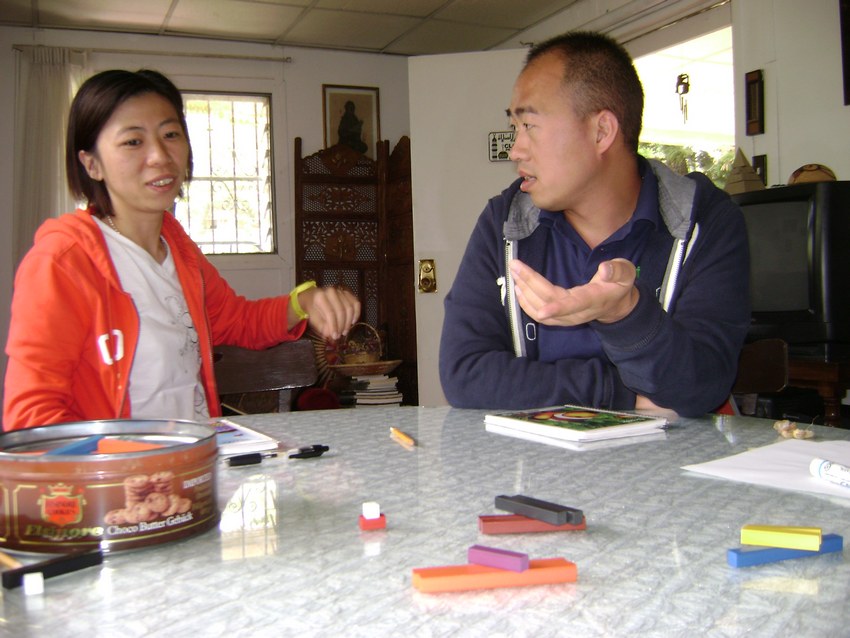
In our classes, students are asked to express whatever they are moved to say, from the trivial to the profound. They are asked to be truthful, and to talk about their lives, their feelings and their opinions in the foreign language: in short, to build the connection between what they want to say and the language that is needed to say it. This connection is, after all, what will allow them to speak in the new language outside the classroom, so in a class based on expression, they are properly ‘training for the task’.
Of course, beginners cannot do this, so we use objects in the room (often Cuisenaire rods) to create situations that the students can become involved in and learn to talk about. As their language develops, their interests and lives, and soon their inner lives, become the focus of the class. The teacher helps them to find the language they need to express their intent.
There are situations where people use language just to provide information, with no expressive element: the job of train announcers at railway stations is simply to announce. But such examples of communication without expression are rare and not at all normal. Their absence of human feeling warns us that inauthentic display language divorced from personal expression, however ‘communicative’, is not real language.
The real thing—authentic conversation—is rich and is easily generated from the people in the room, all of whom have something to say.