In the Silent Way we prioritise developing students’ skills in pronunciation and in using the functional vocabulary. It’s crucial to develop facility in these things early in a course because these are the fundamentals on which everything else in the language depends. We also prioritise spoken over written language.
These priorities mean that a Silent Way course follows a very different sequence from other language courses. We take time at the beginning on these basics, working until the students have gained facility in each aspect, before building new learning on the skills they now have.
The broad framework for students’ progression on a Silent Way course starting at beginner level in a language is set out in the diagrams below (we have two versions, this one for English and this one for French). Of course, the detailed path for any particular course will depend on the teacher and the students on that course.
(Click on the diagram above to view it full size. )
Our framework has the following key features:
speaking and listening precede writing and reading in students’ language development
developing facility in pronunciation and in using the function words—what Gattegno called the ‘spirit of the language’—are the first steps in students’ language development
facility with the ‘spirit of the language’, is the springboard from which to learn how to use the language in any situation and for any purpose
the ‘jigsaw puzzle’ background at the top of the diagram represents the many different ‘domains’ within which people might work towards mastery—one person might be interested in the domain of literature, whilst another what is needed to work as a chef, whilst another for the purposes of travel etc
there are no hard lines between levels, recognising that students’ development isn’t linear and that they are still likely to be working on, say, pronunciation and the subtleties of a language even when they reach the highest levels
Click here for a PDF of the progression framework. Click here to read an article about this framework published by IATEFL in ‘Voices’ in August 2022.
The ‘bubble diagram’
At the bottom of this page you can find links to a full resolution, printable PDF ‘bubble’ diagram showing a syllabus for a course in English using the Silent Way.
The syllabus shown in this diagrams is mapped onto the levels of the progression framework. The students’ journey starts in the bottom left hand corner and finishes beyond the top right corner. The jigsaw puzzle background towards the top right represents the different domains that might be important to individual students: each student will need their own specific vocabulary, for whatever they need to talk about in their lives.
The lines between bubbles show how later bubbles might depend on previous ones. There are many different good routes through this syllabus, so the links from bubble to bubble are not prescriptive: experienced teachers will create their own routes in response to what any particular class achieves moment by moment. And that’s why there are also empty bubbles in the diagram—these are for the teacher to add things that we’ve missed, or that the teacher and her students want and need to work on.
Here are a few features of the diagram:
The bubble diagram gives examples only. These should be explored for singular and plural examples, all pronouns and persons, and/or a variety of numbers and colours, as relevant. For convenience, we assume a female teacher and male students
The bubbles highlighted in blue relate to writing and reading. There are relatively few of them and this reflects the priority we give in the Silent Way to the spoken language.
On the English bubble diagram the items highlighted in green relate to the gradual building up of a comprehensive view of the English verb tense system. The bubbles highlighted in gold relate to the progress of the class in talking about the people in the class, their lives and circumstances. The rectangles coloured pink give advice to teachers about how to proceed, once more of the content of the lessons is coming from the students.
There are some topics in the syllabus that can be tackled at almost any time: to give the class variety or to prepare the ground for something to follow.
Silent Way teachers teach one thing at a time, and work on that until the students achieve a reasonable degree of facility with it. Students cannot achieve perfection straightaway, so teachers take into account the need for students to sleep, to consolidate and integrate what they have worked on.
Every part of this syllabus can be worked on using Cuisenaire rods, a few wall pictures, other objects in the classroom and, as soon as possible, the people in the class.
Silent Way teachers work on one or two of the rectangles associated with any one bubble in any one lesson, and then move on. That way the class revises and develops what they have already done when they revisit this aspect of the language.
Silent Way teachers avoid jumping too many steps ahead of what the class can already do with facility. Having said that, sometimes it’s a good idea to give students a taste of things to come or to respond to an ambitious class. The arrangement of the bubbles is designed to help the teacher keep an overview of the whole course whilst responding, in the moment, to the needs of her class.
In the Silent Way we delay the expansion of vocabulary: adding vocabulary consumes students’ energy that, to start with, needs to be focussed on the more difficult task of mastering the use of the function words.
Work on pronunciation, stress and reduction and intonation suffuses work on every sentence said in class. So once the teacher has laid the foundations for this work at the start of the course, she will revisit pronunciation constantly.
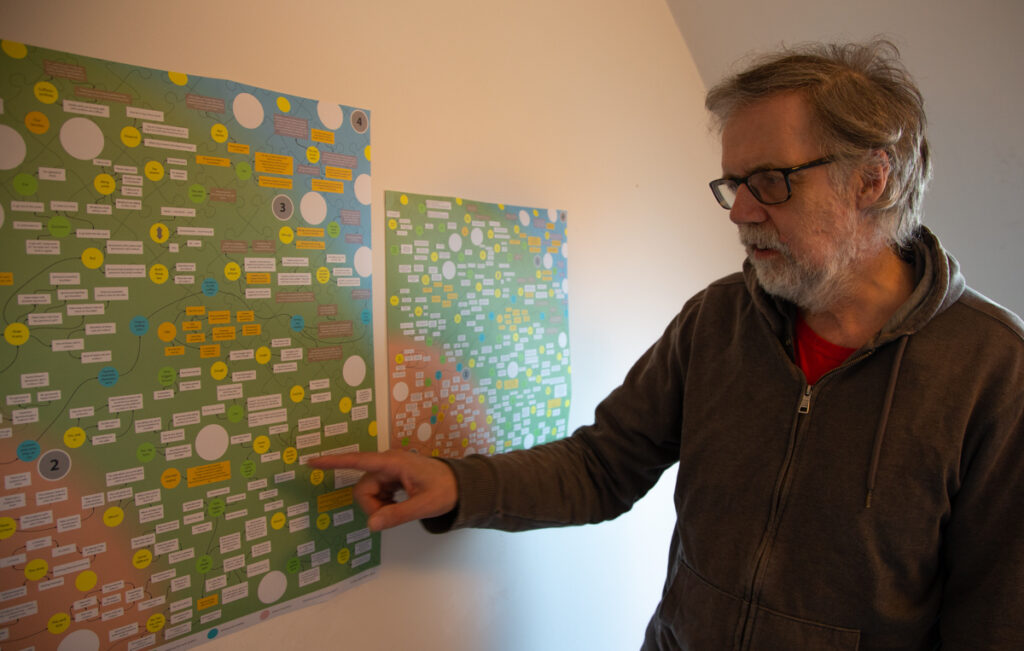
A teacher can also use the diagram to show her class how far they’ve got in their journey to learn the language. It’s often motivating for students to see at a glance how far they have come, and how far there is still to go. The diagram works well printed out on A1 paper (ie about 59 x 59cm). It is still legible though the print is very small on A2 paper (ie about 42 x42 cm). See the picture below.
The English bubble diagram in printed form
Click here for a full resolution printable PDF of the English bubble diagram.
And, thanks to Fanny Passeport and Roslyn Young for this video series explaining what lies behind this framework and the ‘bubble diagram’.