
Learning to write and read in any language requires us to associate graphic symbols with the sequences of sounds used in speech. And, whilst some languages have more difficult writing systems than others, the skills involved in reading and writing are essentially the same no matter what language we are learning.
In a Silent Way course, we start by working on speaking. Once students are reasonably confident with saying simple sentences, we give them the opportunity to write sentences that they can already say from their lessons. We then give them feedback on what they have written. In this way, they build writing skills on top of their already-learned speaking skills.
It is much better if they write these sentences by hand. Writing with pen and paper forces students to look carefully at the shapes they are making and notice the distinctions that native writers make. This is true for all languages whether the language uses an alphabet the students are familiar with, or a different type of alphabetic or syllabic script or an ideographic script.
The students’ written work then forms their own unique ‘graded reader’. Because what they write comes from their own lessons, it is always at the exact level for that class.
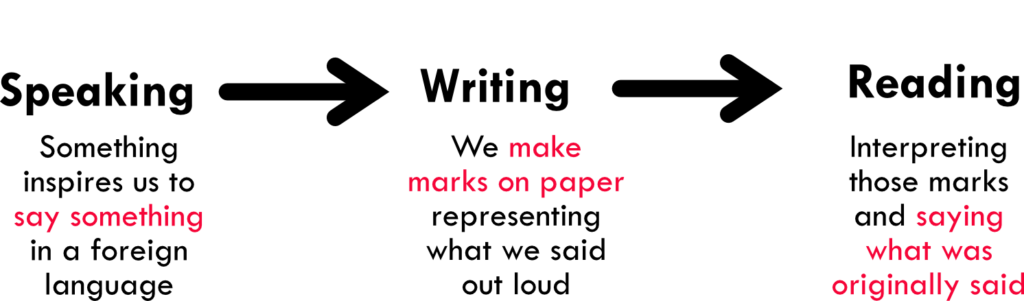
So in a Silent Way course, speaking comes first, writing lags behind speaking and reading follows.
This sequencing works equally well for all languages though it has particular advantages for languages with difficult spelling systems such as English or Japanese, where literacy requires mastery of several thousand kanji characters.
Since students’ writing ‘shadows’ the work done in class, at any one time students only encounter a limited amount of new vocabulary, most of which will be familiar from their lessons. What’s more, these new words will recur in sentence after sentence of the class’s writing. This means that the students will retain how these words are written without recourse to memorisation.