
Every language has its own unique verb system, sometimes more elaborate, sometimes less, which is a key functional part of the language. Students need to master how the forms of verbs change to talk about different situations.
For some of these languages we have created special charts that the teacher can use to help the students get familiar with the whole system.
For example, this French conjugation chart contains prefixes, stems and their variations, and endings. It is a comprehensive view of the whole French verb system, and by pointing on this chart students and teachers can assemble ‘like lego’ the correct forms for any verb in any situation.

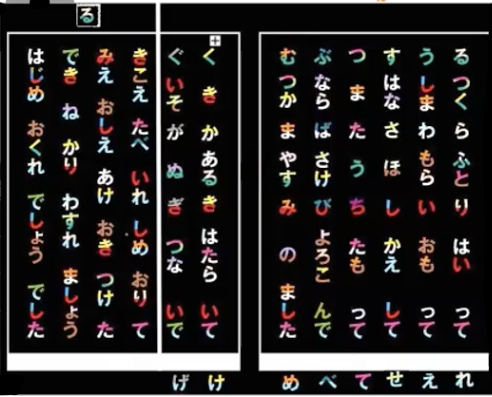
Here’ s a verb chart for Japanese – its structure reflects the very different way that the Japanese language and its verbs function.
In the case of English, where verb endings are very few, key verbs and endings are simply included in the main word charts.
These verb charts are not to be studied, in the conventional sense of that word, nor memorised. Nor are they reference tools. They are pedagogic tools to be used, in the moment, in class to:
As the charts are scanned by the students many, many times through successive lessons, students gradually assimilate the whole of its structure and internalise how the verb system for that language works. This means that drills and memorisation are never needed.