
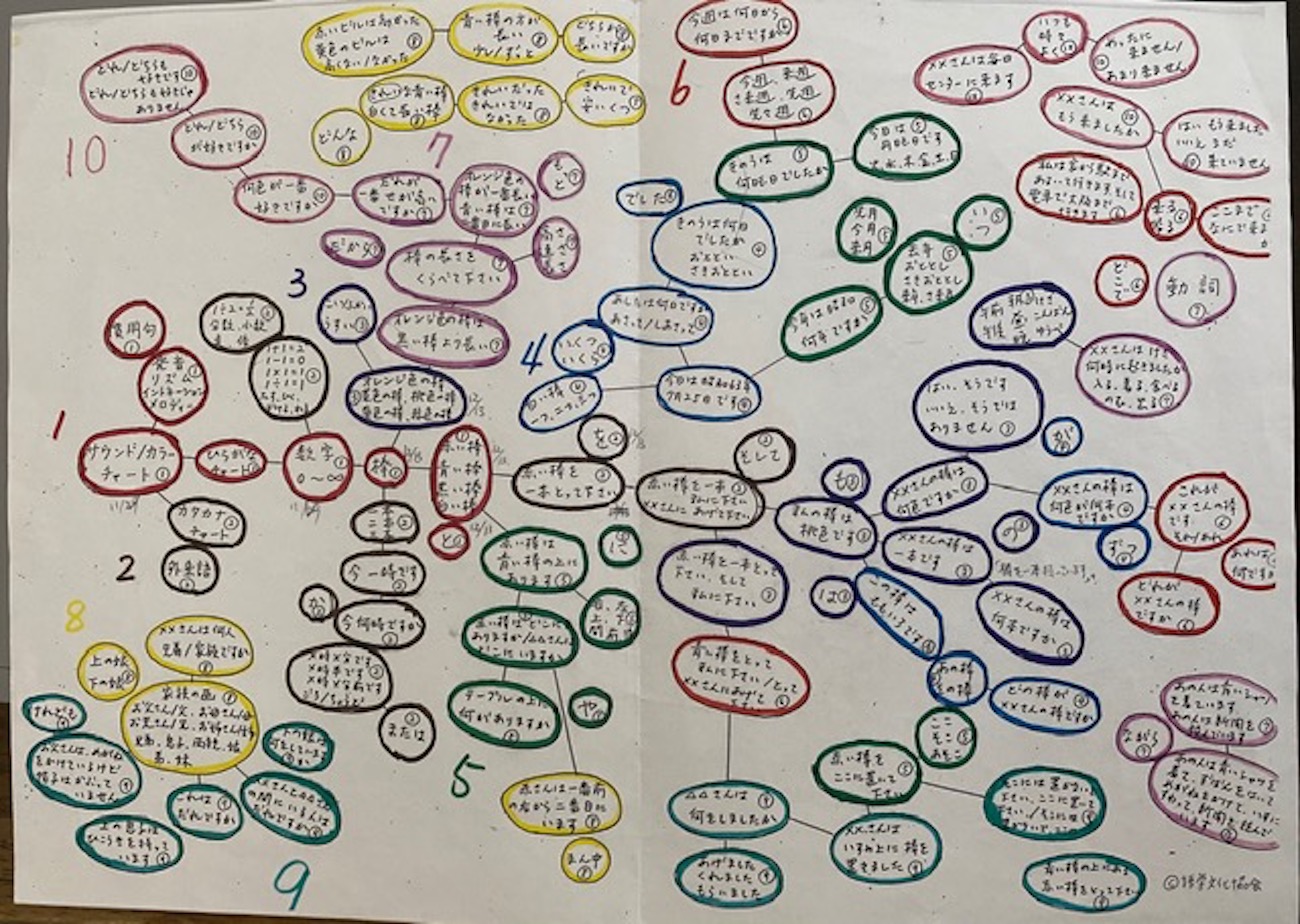
This diagram represents the Japanese language from the perspective of a teacher. Each bubble contains an aspect of Japanese and the connections show how new aspects depend on or grow from previously-worked-on ones. It also shows what a teacher would expect to work on, and give sufficient time for practice on, in a beginners course of around 60 hours.
(Click on the image to view it full size)
For instance, the ten or so black-coloured bubbles in the middle of the diagram are where students work towards saying things like: ‘Please take x blue/red/white/black rods and give them to so-and-so.’
And then work on sentences like:
In order to work on such sentences students need to have already developed facility in the range of more fundamental aspects of the language that these depend on. So the bubbles preceding these ones contain: talking about rods, and colours, counting objects like rods, and numbers themselves. In fact following the lines, we can trace these bubbles back to the very first bubble (the red one on the left, near the number 1)—which is where students work on the sounds of Japanese. Saying anything in a language requires students to have developed reasonable facility at saying the sounds of that language.
Other parts of the bubble diagram show working on sums, the days of the week, spatial relationships, talking about what just happened etc.
This diagram is just one example of how to introduce Japanese to beginners, you could introduce the language in many other sensible orders. Indeed the author of this diagram, Fusako Allard, encouraged teachers to be inventive, saying ‘Please invent better diagrams as you like’.
Experienced teachers keep this kind of overview in mind as they work, moment by moment (even if they haven’t schematised it as in this diagram). It gives them the freedom to take the class into a new area, on the spur of the moment if that is what crops up in the class. But it also gives them a tool to judge when an ambitious class wants to tackle an aspect of the language that is too far ahead, and respond by saying ‘Later!’.
With thanks to Silent Way Tokyo for permission to reproduce this diagram.