
The grammar of a language – how the words fit together, how the language expresses relationships of time, space, personal relationships etc – is not a matter of rules. Native-speakers simply know ‘what sounds right’. And there is no particular reason why one language uses one way of expressing these things and another a different way.
Students often ask “But why do we say X or Y?” and the only answer to such a question is that … “there is no reason: it’s just that speakers of that language have all decided collectively, over time, that that is how they speak.”
So it is much better to learn this part of language by directly associating meaning and the necessary linguistic form.
This is why we: show our classes objects, such as Cuisenaire rods, in various arrangements:
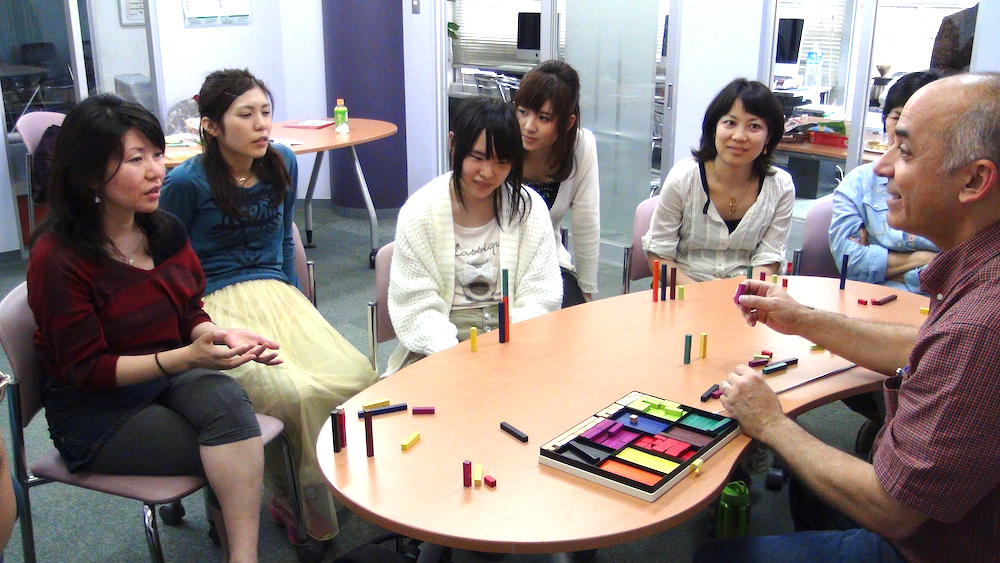
The approach is simple. We set up in front of the class an arrangement of objects, or we get the class to perform a set of actions, or we lay out a calendar in front of them, or we put a picture on the wall – all we need is something simple and clear that everyone can see and understand and which contains the meaning for which we are going to find linguistic forms.
And then, somebody from the class launches a sentence about what is in front of them. And we work on that sentence with the student and the whole class until it is true to the situation and the student’s perception of it, and correct – in other words it is something a native speaker might say if they were there. And then, it’s someone else’s turn.
And over time, the class gets familiar with how native speakers use their language to express all these kinds of things – without any need for rules or explanation or translation, since the meaning is right in front of them for all to see.