
These are central to our teaching because:
They permit us to provide new language and to correct students’ attempts, silently and efficiently.
Pointing, both by us and by students, help them find where the words or sounds they need are on the wall charts, and supplement their looking with a kinaesthetic trace. All of which strengthens their independence of us and their retention of sounds, spellings, words and their relationships.
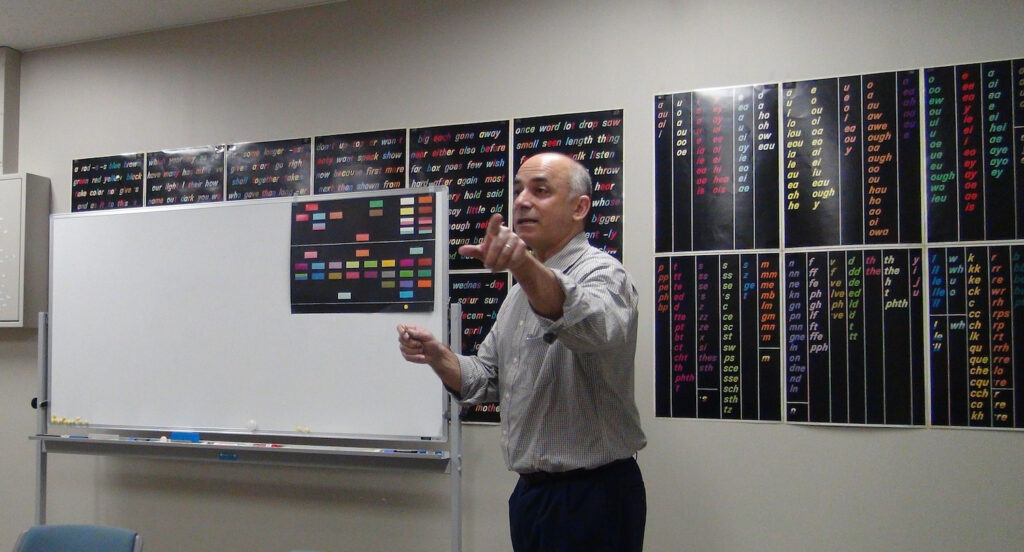
Pointing by the student is a great diagnostic tool, often allowing us, and them, to pinpoint exactly what is the source of mistakes. For example, we don’t always know if a student mispronounces a word whether it’s a) because they have the wrong sound in mind, or b) whether they just haven’t yet mastered how to make that sound. And indeed, there might also be a problem with how they think the word is spelt. Or it might be that it’s the spelling that’s the root cause of the pronunciation difficulty. Getting the student to point on the relevant charts is a very efficient way of finding out what the source of the problem is. Only once we know this are we able to intervene precisely: otherwise we’re flying blind.
So much of our running the class and getting students to talk and giving feedback is better done non-verbally by pointing, gesture, facial expression and mime. Apart from anything else, this means we teach better across linguistic boundaries. Everyone, whatever their native language, comes to know what we mean them to do when we point to a sequence of words on the charts, or wiggle a finger when using finger correction, or gesture the contour of the melody of a sentence, or make the ‘maybe’ gesture, or the ‘try again’ gesture or whatever.
Watch this video to find out more about working with a pointer and charts.