
Details are important, but seeing these details in the context of the larger picture makes a huge difference to our learning. For example, chemists use the periodic table to show all the elements and their families, and how each individual element resembles other family members. A chemist or a chemistry student can see the whole picture in one glance.
We can do the same for language. A well-designed chart showing all the sounds of a language—say, the 48 sounds of American English, or the 46 of Hindi, or the 27 of Spanish—and something about their relationships, enables students to understand that the task of learning the sounds of the language is finite; that these sounds come in families with relationships; and that where they are positioned on the chart relates to where and how they are made in the mouth.
Hover over image to magnify
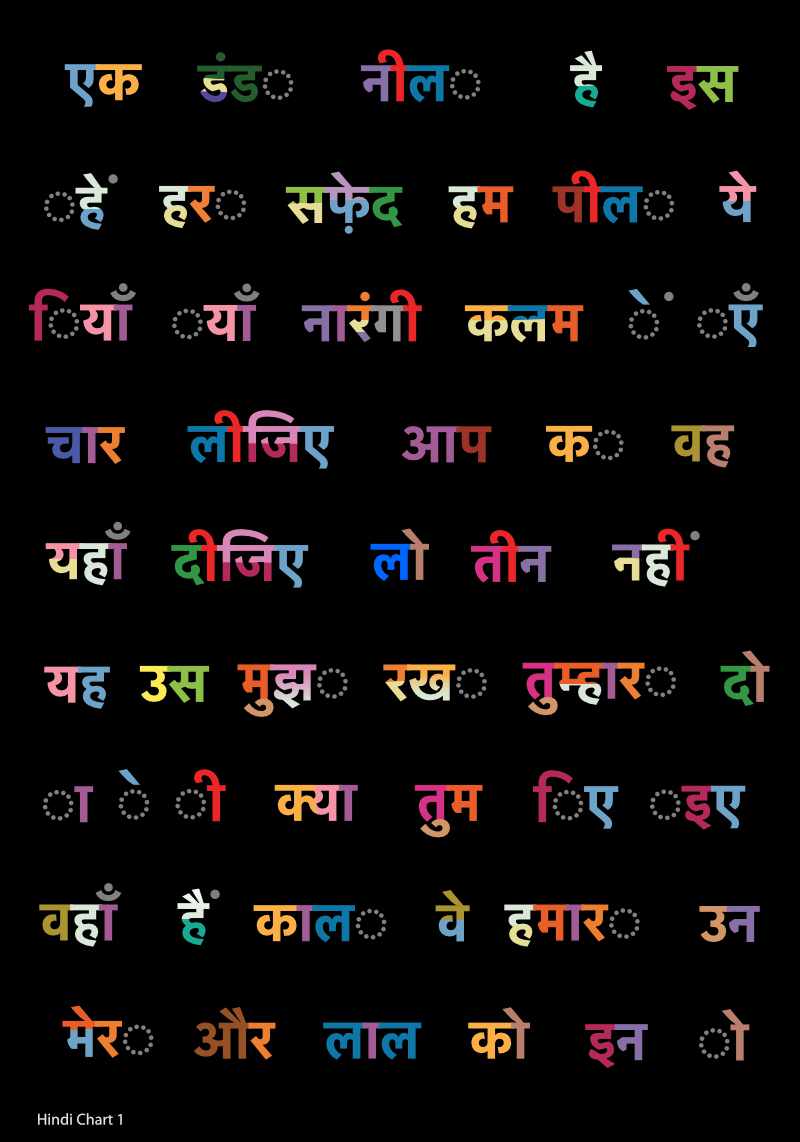
Charts of the functional vocabulary of a language (like the one above for Hindi) tell a student that if he knows how to use all these words, then he knows more or less all the grammar of that language.
For many languages, a sound-spelling chart tells students that spelling is not as arbitrary as it might seem and that there are only a finite number of ways of writing each sound (depending, of course, on the language).
These charts are our equivalent of the periodic table: pointing to elements of the language in their place on these charts shows them in context. And this context makes it far easier for students to work out how to use them, to find them when they need them and to retain them after a short period of working with them.