
The series of films on this page come from an English lesson given at Hiroshima International University in October 2025. The students were studying subjects related to medicine and English is a ‘required’ course for them. The University term in Japan starts in April, so this lesson was from the second semester. This means that the students had worked with the teacher, Don Cherry, for some months.
(more…)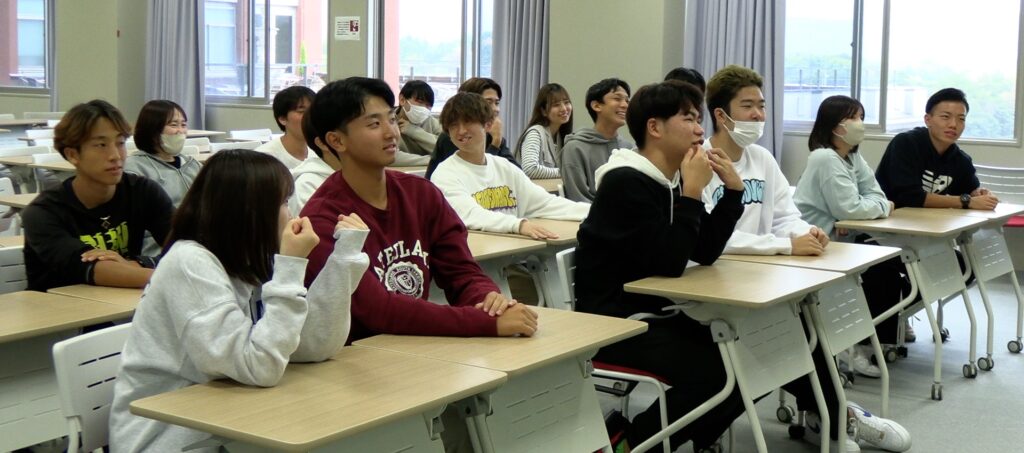
In this project we’ll video six English classes given by teacher Don Cherry at Hiroshima International University. Don has been teaching English in Japan for over 30 years using the Silent Way and is expert at teaching in this kind of environment. We’ll be documenting more of the techniques he uses through this project. Check out our previous project with Don from 2023 here.
Filming starts late October 2025. Assembling the footage, translating the interviews and editing will start in late November once filming is complete and we expect the first videos to be published in January 2026.
We’ll be posting updates on this page as the project progresses, so watch this space!
Watch this video to see how one teacher works with students from all kinds of backgrounds at all kinds of levels to develop their Spanish using the Silent Way. With thanks to Cesar Farfan for this video.
Hello there! It’s been almost 3 years since I found about Silent Way and I have to say it has made a huge difference in both my students’ Spanish learning and my effectiveness as a teacher. I hope you enjoy this sample of my recent work.
Cesar Farfan
This project aims to develop the materials and the skills to use them to teach spoken Catalan to beginners using the Silent way. It’s a collaboration between two native speakers of the language and the silentway.online team.
(more…)This series of short videos come from an interview with Roslyn Young who shares her 50 years of experience in the language classroom. Use them as stimulus for your own reflection on your own teaching and learning and think about how to apply the ideas Ros shares in your own work.
This article analyses a particular Class Conversation from a real lesson. The purpose of this analysis is to show how the Class Conversation approach enables intermediate students to improve their speaking skills. The content of the lesson is provided entirely by the students – the teacher’s role is to make sure that each sentence is corrected and then practised. Sometimes the teacher also needs to prompt students to go deeper or to keep the conversation going.
(more…)Don Cherry has been teaching English in Japan for over 30 years using the Silent Way. This film is part of a project to document some of the techniques (both language building and classroom management) that he uses to teach his students at Hiroshima International University.
All the students were 18-year-old Japanese students, and on health related courses like pharmacy or physiotherapy etc. There were around 30 students in each of the classes we filmed. English is a required course as part of their university studies. All the students had already had at least 6 years of learning English at school. Filmed during October 2023 at Hiroshima International University.
In this lesson the students had to instruct Don to take the steps to play a CD in the CD player. The lesson builds from the very simplest elements, step-by-step until they have to give the full set of instructions required. The lesson also included work on pronunciation, rhythm, word order, prepositions etc – in other words many of the things that make English ‘English’. The class was one of Don’s regular classes and had worked with him over about 6 months, having had 18 or 19 weekly 90 minute lessons.
Practice is necessary to learn a skill, whether physical or mental. For us, neither repetition nor rote learning is practice. We use practice to speak about activities which require the presence of the doer. Repetition can take place even while the person executing a movement is mentally absent from what he is doing, thinking about something quite different.
(more…)aleb Gattegno talks about the inner ‘movements’ that underlie the grammar of a language and that the grammar of a language has really become part of a student when changes in the situation causes a change in the words he uses.
(more…)A student is working towards the sentence “A black rod and two green ones and a yellow one and a brown one.” You can see the “Aha!” moment at 2 min 56 secs when he becomes aware of the significance of ‘ones’. And afterwards, he can do something he could’t do before … albeit it probably needs practice.
(more…)