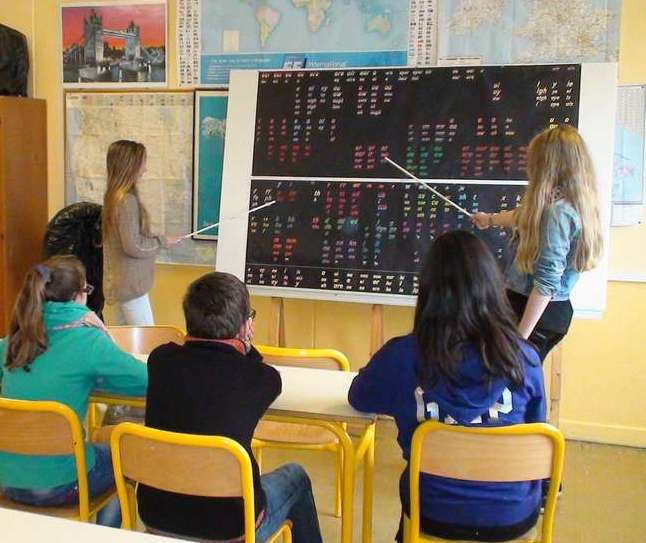
It’s always better, at every level, to learn together with other students and practice the whole process of expressing yourself in a foreign language: from your thoughts through to using your muscles to make the foreign sounds of foreign words in the foreign sentences you need to express your idea. And everyone learns from everyone else in the class: a mistake is a gift to the class.
Two students working together on the spelling chart (Fidel)
Learning a language together in a group is far more effective than learning solo. Here’s some reasons why:
Language isn’t an abstract or artificial game with ‘rules’ and ‘points’ for correct answers, it’s the principal way that humans express their thoughts, feelings, perceptions, instructions, ideas and opinions and share them with others. So it’s always better, at every level, to learn together with other students and practice the whole process: from your thoughts through to using your muscles to make the foreign sounds of foreign words in the foreign sentences you need to express your idea. Learning this way means you’ll be ready, quicker, for all those spontaneous real-life encounters that your new language is for.
Whilst someone else in the class is working on a sentence, you can work along with them too. If you’re already fairly confident of how the sentence should go, then observing someone else working will help strengthen and reform your internal criteria. If you have no idea about what needs correcting then you’ll gain new awarenesses from observing.
A group gives a chance to work, authentically, on every aspect of the language. For example, situations requiring sentences like ‘Give them x!’ or ‘Take his chair and put it with theirs’ etc are inevitably contrived if you are learning on your own.
When the focus of the class moves to another person, you have the chance to process what’s just happened or is happening. You can take a breather or a rest, whilst you work on the experience internally and subconsciously.
Other members of a group can help the student who’s the current focus of the lesson, so teachers can stay more in their proper role as coach to the whole class. Otherwise teachers risk becoming perceived as the sole authoritative source of correct answers.
And watching others, whose perspectives, strengths and weaknesses are different from yours, as they experiment, try things out and gain new skills, will give you insights and inspiration you could never get on your own.
In fact, larger groups are nearly always preferable to smaller groups: we all learn more together, more efficiently and more effectively.