
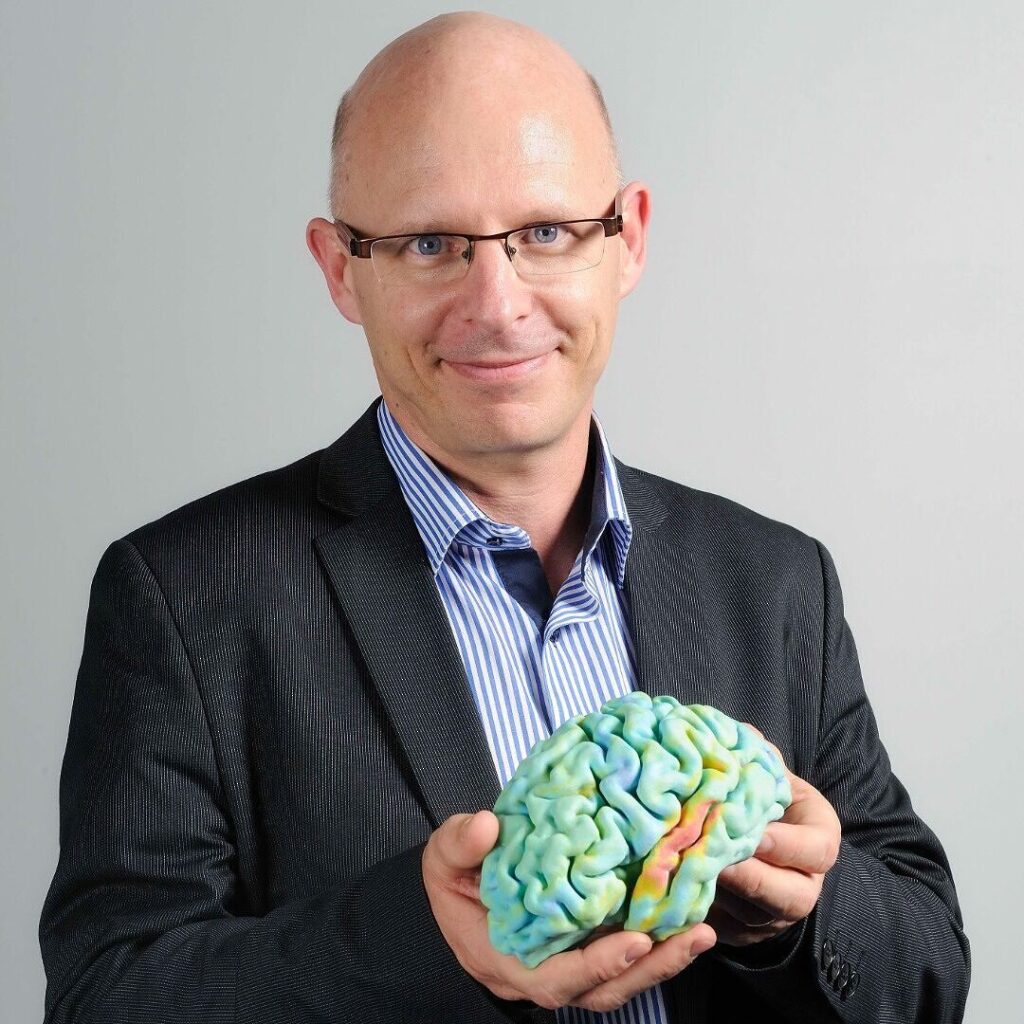
The French neuroscientist Professor Stanislas Dehaene writes:
[L]earning does not occur passively through simple exposure to data or lectures: on the contrary, cognitive psychology and brain imaging show us that children are budding scientists, constantly generating new hypotheses, and that the brain is an ever-alert organ that learns by testing the models it projects onto the outside world.
Dehaene, 2020, p.238
Whilst Dehaene refers to children, the same is true of adults. Adults, of course, are different from children in that they already have more knowledge of the world and more established skills. But their brains still possess a disposition for learning, constantly adapting and rewiring themselves based on experiences and stimuli.
Dehaene sets out ‘four pillars of learning’ – attention, active engagement, error feedback and consolidation – which he describes as follows:
During evolution, four major functions appeared that maximized the speed with which we extracted information from our environment. I call them the four pillars of learning, because each of them plays an essential role in the stability of our mental constructions: if even one of these pillars is missing or weak, the whole structure quakes and quivers. Conversely, whenever we need to learn, and learn fast, we can rely on them to optimize our efforts.
Dehaene, 2020, p.145
Dehaene says, ‘Teachers should become masters at capturing their students’ attention and directing it to what matters.’ (Dehaene, 2020, p.241)
The most common way that a Silent Way teacher captures her students’ attention is by using a pointer with a set of wall charts. This simple technique is extraordinarily effective in creating joint attention focused on the task in hand between the teacher and the whole class. To find out more watch this video.
Dehaene says, ‘as soon as learning concerns high-level cognitive properties … learning seems to occur only if the learner pays attention, thinks, anticipates, and puts forth hypotheses at the risk of making mistakes.’ (Dehaene, 2020, p.179)
Silent Way teachers set up situations which draw students into experimenting, trying things out and hence building their own implicit inner criteria for the language. This is central to our approach: we don’t give rules or explanations, and we don’t just give the correct answers and get students to copy us. But neither do we leave students to flounder on their own: we guide their experimentation, providing what they cannot discover or guess for themselves and steering them towards their own correct and accurate sentences. This is a subtle process requiring teachers to develop the skills to judge how much help and guidance each student and each class needs at any particular moment. Surprisingly little help is usually all that is required.
You can see an example of a teacher giving a student the time necessary to experiment in this video. At 3:50 the teacher pinpoints where there is a problem and the student tries a couple of possibilities until the penny drops and he works out what he needs to say. (You are probably better starting to watch the video a little earlier than this to get the context – and don’t worry that it is from a Japanese lesson, if you watch carefully you will see what is going on even if you don’t know that language).
Dehaene says, [O]ur brain can adjust its models only when it discovers a discrepancy between what it envisioned and reality. (Dehaene, 2020, p.238)
This is absolutely crucial, and it is the central job of the foreign language teacher. Only a teacher can provide the precise feedback a student needs on his pronunciation and correctness, and on the appropriateness of what he says to the situation.
What’s more, students need this feedback straightaway.
‘[S]tudents must … quickly receive objective, non-punitive feedback that allows them to correct themselves.’.
Dehaene, 2020, p.215
In the language classroom this feedback is best provided immediately, sentence by sentence in response to what the student has just done. The kind of written comments or grades that are sometimes called ‘feedback’ are largely useless because, as Dehaene points out ‘they are also often delayed by several weeks, at which point most students have long forgotten which aspects of their inner reasoning misled them.’ (Dehaene, 2020, p.211)
This is why one of the key skills that a Silent Way teacher develops is the ability to provide this kind of immediate, precise, non-judgemental feedback, sentence by sentence. And in a way that means that all the other students in the class can see what is happening, maintain their attention and therefore also learn alongside the student whose sentence happens to be the focus of the class at that moment.
For example, in this video you’ll see the teacher providing immediate feedback that enables the student to improve and make his French more natural, using only the most economical of gestures. This also shows the difference between ‘providing feedback’ and ‘correcting’: the teacher didn’t actually correct, it’s the student who did that work. As Gattegno said, ‘I work on the students; the students work on the language.’
Dehaene says, ‘Whether we learn to type, play a musical instrument, or drive a car, our gestures are initially under the control of the prefrontal cortex: we produce them slowly and consciously, one by one. Practice, however, makes perfect: over time, all effort evaporates, and we can exercise those skills while talking or thinking about something else.’ (Dehaene, 2020, p.223)
The Silent Way teacher knows that students need enough practice under supervision in class so that the process of developing criteria for correctness and of automating the new skills they have been working on has been started. Indeed, at the end of the video referred to above (see here), both the student commentator and the teacher articulate this very well.
But Dehaene also says:
‘[W]hile we sleep, our brain remains active; it runs a specific algorithm that replays the important events it recorded during the previous day and gradually transfers them into a more efficient compartment of our memory.’
Dehaene, 2020, p.224
‘Experiment after experiment gives convergent results: after sleeping, brain activity shifts around, and a portion of the knowledge acquired during the day is strengthened and transferred to more automatic and specialized circuits.’
Dehaene, 2020, p.228
‘To learn a skill as complex as a new language, the only thing that works is practice during the day, then sleep during the night to reactivate and consolidate what we acquired.’
Dehaene, 2020, p.230
So the Silent Way teacher knows that students will continue improving what they have worked on providing it has been sufficiently practised. That said, we never expect students to know or remember any particular thing just because ‘we’ve covered it in a previous lesson’. Students nearly always need to become aware of, and work on, aspects of the language several times and only gradually get familiar with them.
Indeed, this leads to a more general point about teaching and learning. Since it is the individual student himself who is unconsciously rewiring his brain in response to his experiences with the language, we should not fall into the common assumption that there is a causal relationship between what we teach and what is learnt.
The four pillars all work together. Students just being active is not enough. Activities need to direct students’ attention to the things they are supposed to be learning: it is very tempting to devise activities that might be fun but these may actually distract from work on the language. And attending and being active is not enough: students must also receive precise feedback, if what they are doing is to lead to improvement. And finally, unless they also get enough practice, what they have worked on with attention, active engagement and feedback will leave weak traces in their minds; so they will gain less learning for the time they spent than they could have.
We recommend Dehaene’s book. You will find it interesting to reflect on how well your teaching aligns with these ‘four pillars’. We’d love to hear from you about what you discover. Please use the form below to message us!
Dehaene, S. (2020). How we learn: The new science of education and the brain. London: Penguin Books.