
The starting point for good language teaching is students saying things they want to say.
As John Holt put it:
“It can’t be said too often: we get better at using words, whether hearing, speaking, reading, or writing, under one condition and only one—when we use those words to say something we want to say, to people we want to say it to, for purposes that are our own.”
John Holt, How Children Learn (1967)
Silent Way teachers achieve this for non beginners by using the Class Conversation. Someone starts off the conversation with something they want to say. And then others respond as they would in any conversation. And the conversation continues for the whole lesson.
In between these exchanges, the teacher gets the students to rectify what they said until each sentence sounds as native-like as possible given their level, i.e. the choice of words is appropriate, their order is correct and the pronunciation is as good as the students can manage at the time.
And then the class picks up the conversation again.
Check out this video from 2024 to find out how to implement the technique with a small class online.
Here’s some video from an English course held in France in 2014 which had about 35 students, and held over two weekends. This video is from the second weekend.
And finally this series of videos from 2021 illustrates the technique with a small group of students of French face to face. Click here to find out more about the event these videos came from.
If you want to watch all of these videos, they are also in the playlist here.
It takes a few lessons for a class to realise that it’s up to them what they talk about, but then it becomes second nature. Here are the ideas with which some of our class conversations have started:
It is easy for a Class conversation starting from students’ ideas like these to provide the content for an entire lesson.
What this means is that whatever anyone says in class arises out of an urge to speak within them. And when students cannot say something correctly, but genuinely have something to say, their error creates a ‘teachable moment’: they are poised to notice and integrate the new facet of the language that the teacher introduces to help them express their idea. And everyone else in the class learns by observing and being part of that experience.
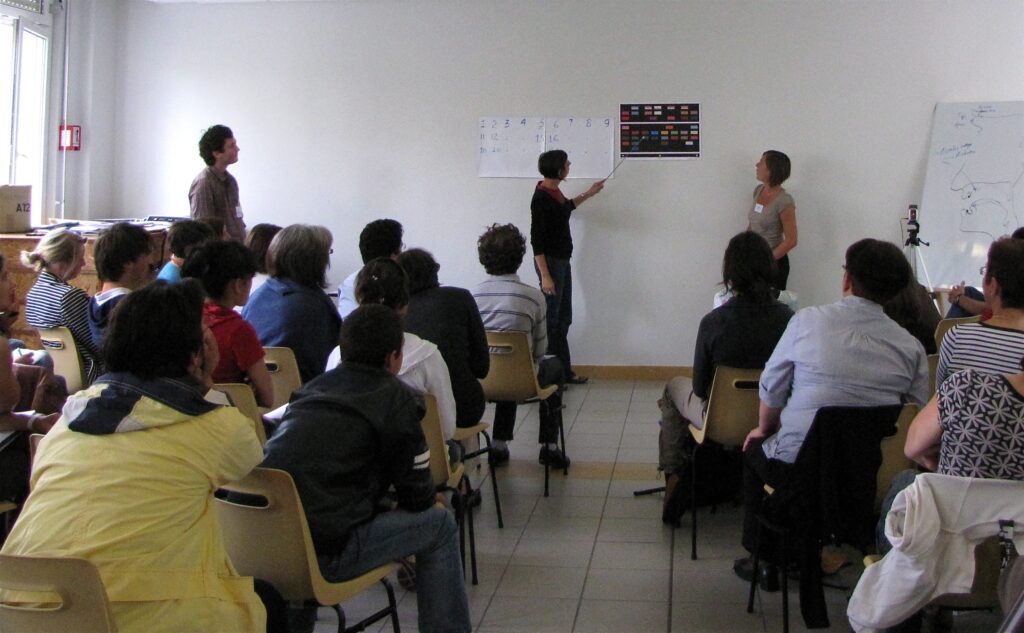
There are three rules for the students:
And just one rule for the teacher:
The class conversation is for classes and students who already have some of the language. The conversation moves forward as follows:
When you start out teaching using Class conversations, you will need about eight to ten students to have enough variety in the conversation, so start with about that number. When you have a bit more experience with this and start to feel more at ease, then you can increase the number of students. Teachers who have had practice using this technique can work with classes of 35 or more.
Students need to learn how a Class Conversation is conducted. So the teacher seeds the first few Class Conversations by giving the students an open question such as, “What did you do last weekend?” or “What are your plans for the summer?” and helps them to take the question where it would naturally go if they were speaking their native language.
Once students realise that these conversations are genuine exchanges and that the teacher takes no responsibility for the content, the conversations become as interesting as the students can make them and very often they come to class energised and ready to launch a conversation with a topic they are interested in.