
Drawings and pictures are very useful to evoke in the language classroom more situations that students can learn to talk about, once they have a secure foothold in pronunciation and the functional vocabulary.
A wall picture forms a focal point that gathers the class’ attention. The teacher and the students can point to items in the picture and practise the relevant vocabulary and create sentences about what they see in the picture. The picture is a spur for students to use their imagination to produce sentences, which use whatever vocabulary and structures they possess to make sentences which are theirs. As in all our work, the teacher works with the students, sentence-by-sentence on what they say until everything is correct, appropriate and well-pronounced.
For these purposes a good wall picture contains little detail and shows a situation that is open to different interpretations. The more detail there is in a picture, the more there is to simply name and describe, and therefore, in any lesson, the less time there will be left for the students to engage with the scene using their imagination. Such pictures tempt a teacher to give students long lists of vocabulary with which students only weakly engage.
Check out this video series to see how a teacher used an image in a class to deepend intermediate students skills in Japanese. Don’t worry if you don’t speak Japanese, the film has been made so that you’ll still be able to see what’s going.
Here are some of the pictures which Caleb Gattegno published in 1965, and some of the things a teacher might do with them.

A group of beginners might simply describe the picture. A class of intermediate students might respond to an invitation by the teacher who simply states: My bedroom is not like this. Advanced students might speculate about why the person who got out of bed didn’t put his slippers on, or anything else they might be inclined to wonder about: the choice can be left to them. If the teacher is silent for thirty seconds, someone will have something to say. (This picture is the one used in the classes illustrated in this video series.)
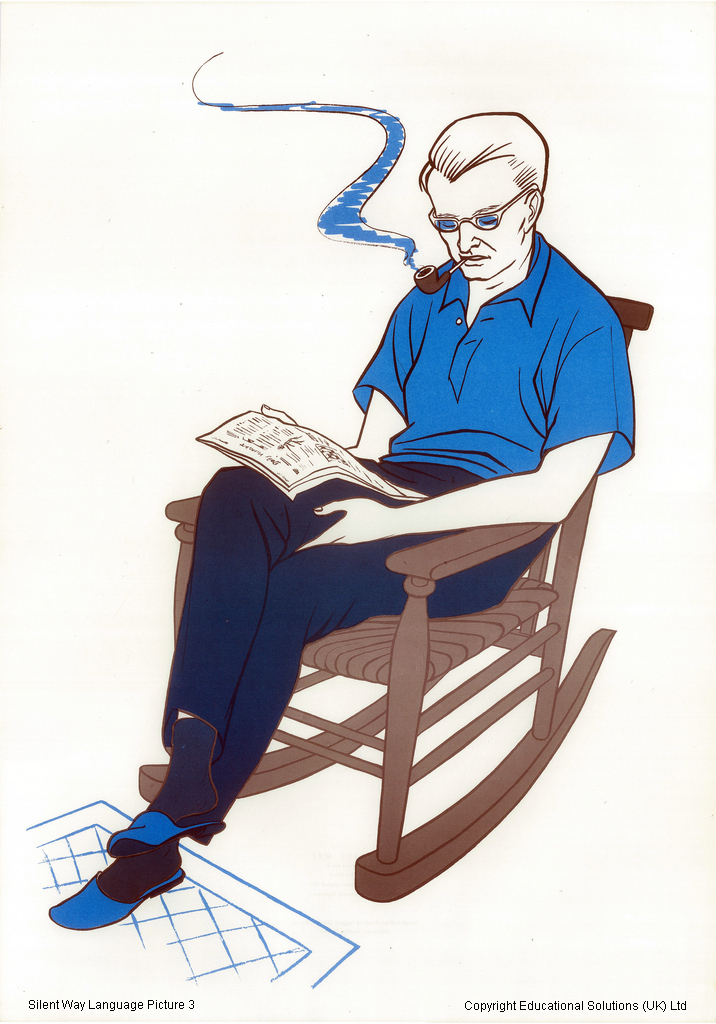
A man sitting in a rocking chair, smoking a pipe and reading a newspaper. Who is he? What do we know about him? What do we not know about him? What might we invent to say about him, beyond simply describing the scene?

A cat walking through a door. The only colour in this picture is orange. We don’t know which room the cat is leaving, nor which one it is entering. Or is it going outside? Once the objects visible in the picture have been named—there are about twenty of them—what is there to say about this scene if one is being purely descriptive? Very little, and that is the point.
This work is about the students expanding their use of the functional vocabulary across a wider range of situations. Whilst this work will also help the students get familiar with a slightly wider vocabulary, learning vocabulary is not its main purpose: the focus should remain on students expressing themselves.