
Don Cherry has been teaching English in Japan for over 30 years using the Silent Way. This page is part of a project to document some of the techniques (both language building and classroom management) he uses to teach his students at Hiroshima International University.
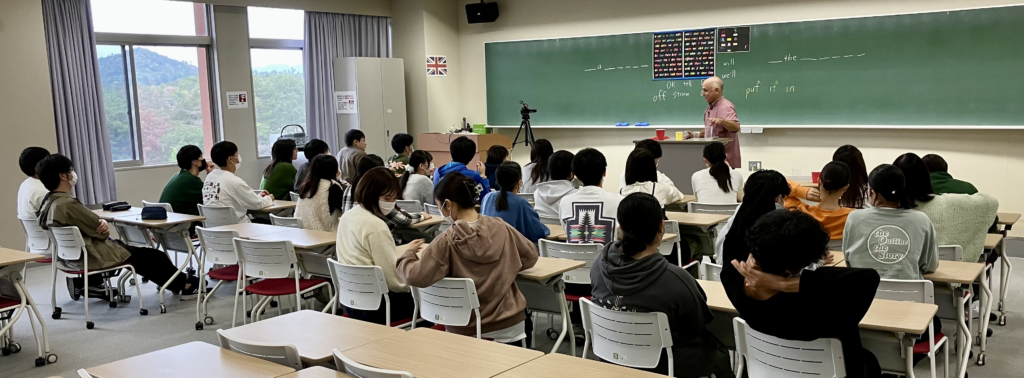
All the students were 18-year-old Japanese students. There were around 30 students in each of the classes we filmed. English is a required course as part of their university studies. All the students had already had at least 6 years of learning English at school. The particular group of students shown in the lesson analysed on this page had been working with Don since the beginning of the academic year (April 2023). Filmed during October 2023 at Hiroshima International University.
This page analyses one 90 minute lesson. To watch the full, unabridged video of that class click here. This is valuable to get a sense of how the lesson was paced. The headings below refer to the timecodes in that video, so you can jump to each section of the full class by clicking on each heading.
We have also edited video from selected incidents in the class along with commentary from Don about what he does and why. These short videos are displayed below, but you can also watch them as part of this playlist.
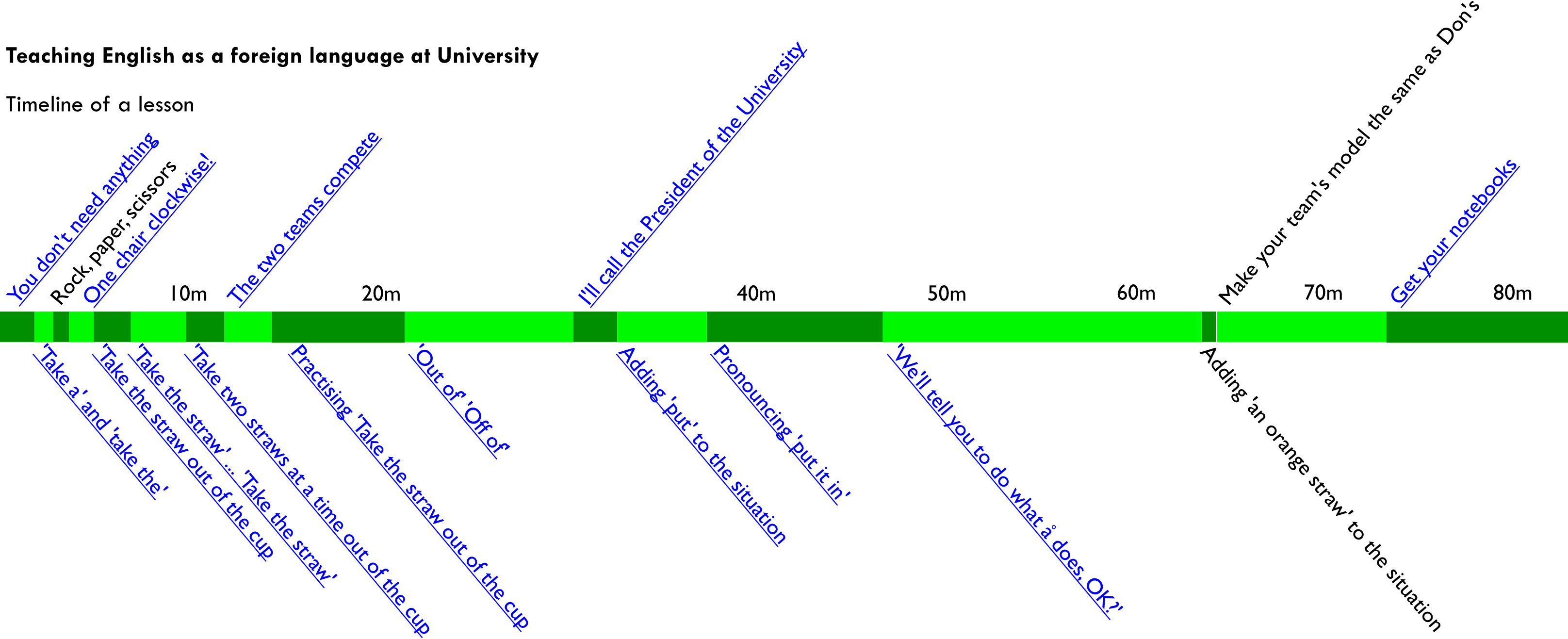
The diagram below shows a timeline of the whole lesson. Click on the diagram to download an interactive PDF including links to the short videos shown on this page.
Don tells the students to put all their bags out of the way at the back of the classroom. Watch this video to understand why he does this.
Don introduces ‘take a’ and ‘take the’ and the students practise saying just these two phrases. Then Don says them and asks the students to point to whichever one he says.
This is the start of the slow build up of the language he wants them to learn. Throughout this lesson you will see how he works, building one step at a time and making sure that the students practise thoroughly each step before the next one is introduced.
Don uses ‘Rock paper scissors’ to organise how they practice in pairs, saying the phrases whilst their partner points.
Don gets the class to change desks moving one chair clockwise. This keeps them physically moving and energised, means that they sit next to different people all the time and sometimes are at the front and sometimes further back.
Don starts the students working on the sentence ‘Take the straw out of the cup’. This gives the chance for the students to work on lots of really important aspects of English – the schwa, linking words together and rhythm.
Don starts working on the distinction between ’Take a straw …’ and ’Take the straw …’. Something that is alien to the Japanese language. Sometimes the students don’t say the right one and Don gives them feedback.
They start working on asking Don to take out two straws at a time. They have to get the plural of straw right as well as the distinction between ‘take two straws’ and ‘take the two straws’.
Don uses a pack of cards to select at random members of the two teams to give him instructions. He gives feedback in various ways, one of which is that he only does what the student asks if the sentence is correct for the situation.
He invites one student to try and when she doesn’t get the distinction quite right for the situation on the lectern, he helps the whole class with the correct sentence. (Note: sorry the numbering on the videos got accidentally swapped at this point)
Don adds a new element to the lesson by asking the students to get him to take out two straws at a time. But this seems too easy for them so he adds ‘off of’ to their sentences.
Don gets the students to practise so that they can speed up saying their sentences. This is part of the process of them gaining facility with this part of English.
Don makes the situation a little more complicated by adding one thing – the action of putting the straws into a cup on the right hand side. And the students really have to work to get the articles ‘the’ and ‘a’ right.
Don helps the students to say this in a natural way, by linking the words together, and by getting them to use the american pronunciation of the letter <t> in this kind of sentence.
Don takes the students another step forward by setting up a situation where they will have to tell two of their classmates to do the same things as he is going to do with the straws and cups.
The class gives the two students at the front instructions to carry out, while Don plays his role of coaching them to make sure the language is correct and accurate.
The game continues but each time the students have to generate and practise new language to reflect the changing situation.
The game continues and the work the students have been doing shows signs that it’s paying off.
Don adds orange straws to the situation and then invites the teams to give instructions to the students at the front to make their model the same as the one on the lectern.
At the end of the class, Don gives the students the opportunity to write down any sentences that occur to them from the work they’ve done in the class.