
Watch how the teacher worked with the class on a new word – purple – which they needed. Because he has already done a lot of work on the sounds and rhythms of English he can quickly and silently enable them to know how this would should be pronounced in a pronunciation micro-lesson.
(more…)Dr Gattegno explains why counting and the numerals are introduced early in the Silent Way. They give great practice in pronunciation and rhythm and the ability to say long utterances. And for most languages students can quite quickly get to say very large numbers independently – a morale booster.
(more…)The class is working on the sentence “Take one of the straws out of the cup”. The teacher uses his fingers to help them group the words correctly in the way an English speaker would. English natives expect to hear words in groups like this, with this kind of rhythm so they can extract the meaning from the stream of speech. This is a key technique in the Silent Way approach.
(more…)In this video the students experience the differences between ‘I am going to go …’ and ‘I am going …’ and ‘I have gone …’ and ‘I went …’; learning to associate these experiences and these words; and practising how to say their sentences with the right emphasis, rhythm and melody.
(more…)A class is working on the sentence “He put his beer on the table”. The teacher enables the students to link the words together. Notice how the words “He put his” are linked together so that they sound like “He pu tis”, because this is how English-speaking people would say it.
And notice the economy of means the teacher uses to achieve this result, without any words or explanations.
(more…)Caleb Gattegno talks about working in the space between what students know how to do and what they don’t. This is the most efficient place to teach.
(more…)The teacher, Don Cherry, knew the students needed to work on pronunciation and if they laid the foundations for good pronunciation early in the course, it would stand them in good stead for all of the work they would do thereafter. Watch this video to see the class getting started with work on some vowels: Working on Sounds (5m 17s).
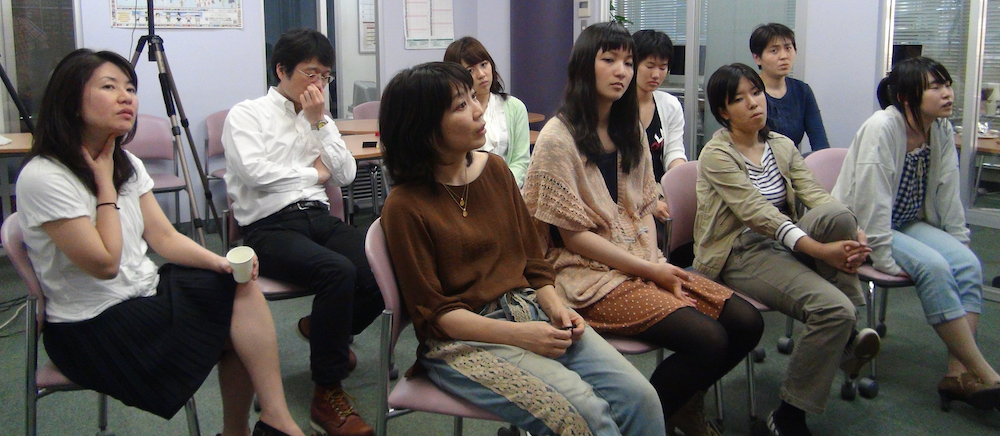
Of course, in addition to working on the sounds themselves, these first few moments also established some of the ways they were going to work in the rest of the course: with charts and pointer; with the teacher being largely silent, but giving lots of feedback; and with great pronunciation being a priority.
Then he introduced a consonant, in this case the consonant /p/ and started the class combining this sound with their repertoire of English vowels: Introducing a consonant (5m 49s). The Silent Way is based on a four stage model of learning and this video illustrates all of these stages at work in a real classroom.
Given the prevalence of the Schwa sound in spoken English and how difficult it is for speakers of languages like Japanese that have nothing at all like this sound, Don started work on this sound straight away, coaching them to make this short, low-energy, unclearly pronounced sound: Low energy sounds – introducing the schwa (2m 56s).
Once the students had made some progress with the schwa, Don turned to another aspect of English which is alien to Japanese speakers. English is full of syllables which end in a consonant. This type of syllable is not possible in Japanese, so Japanese speakers will tend to add an extra vowel to make the syllables conform to Japanese expectations. To keep the class focused and minimise any memory burden, Don was deliberately still working with a very restricted range of sounds. In this film you’ll see him working with these sounds in different permutations and combinations: Permutations and combinations of sounds (2m 27s).
Don then expanded this work, adding two new consonants /b/ and /m/and taking the opportunity to help the students further improve on what they’d done so far. You can see how he did this in this film, Introducing two new consonants (2m 56s), which also shows how the work on the schwa, which you may have seen in an earlier film, was starting to pay off.
Next Don started to work on another vowel sound and explored the differences between this vowel and its neighbouring ones. This kind of work helps students to increase their ability to discriminate between the many more vowels that English has compared to their native language, Japanese. You can see this happening in this film: Working on another vowel sound (2m 47s). Don continued this work on vowels in the next film adding another vowel to their repertoire and doing more work on the ones they had encountered before: More work on vowels (2m 53s). And he introduced a sequence of yet more vowels in this film: Still more vowels (3m 18s). By this point the class had explored 10 of the full vowels of American English: they would need to do more work on these, but the way Don works meant that they would get plenty of chance to improve these throughout the rest of the course
Don finished up this first hour-long session with some practise with the two words ‘mop’ and ‘map’ helping the students to automate the skills they’d been working on so far: Practising ‘mop’ and ‘map’ (2m 1s)