
These pages will provide an analysis of a six-day intensive English course given in Tokyo, by Don Cherry, in 2012. We've provided a description of how the course developed, links to videos examining key moments and commentary on some of the underpinning rationale for the way the teacher worked
With thanks to Don Cherry for providing us with this invaluable material. To see more of his video visit his YouTube channel Don E. Cherry.
The teacher, Don Cherry, knew the students needed to work on pronunciation and if they laid the foundations for good pronunciation early in the course, it would stand them in good stead for all of the work they would do thereafter. Watch this video to see the class getting started with work on some vowels: Working on Sounds (5m 17s).
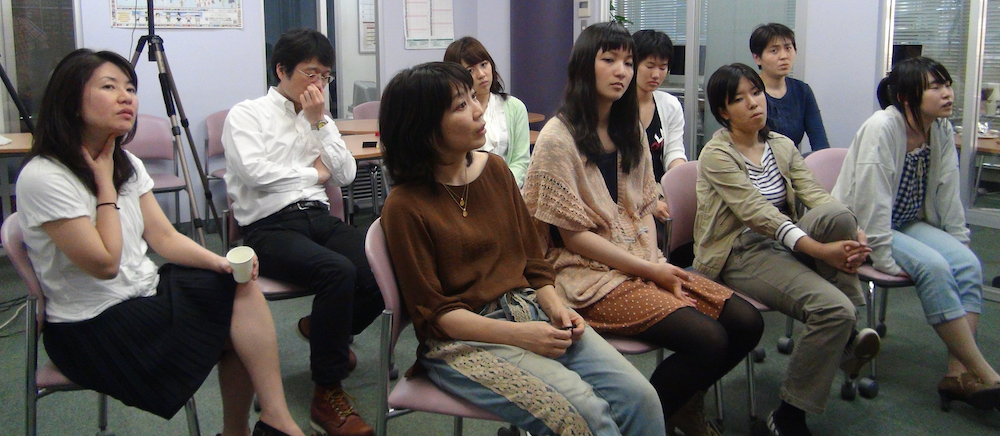
Of course, in addition to working on the sounds themselves, these first few moments also established some of the ways they were going to work in the rest of the course: with charts and pointer; with the teacher being largely silent, but giving lots of feedback; and with great pronunciation being a priority.
Then he introduced a consonant, in this case the consonant /p/ and started the class combining this sound with their repertoire of English vowels: Introducing a consonant (5m 49s). The Silent Way is based on a four stage model of learning and this video illustrates all of these stages at work in a real classroom.
Given the prevalence of the Schwa sound in spoken English and how difficult it is for speakers of languages like Japanese that have nothing at all like this sound, Don started work on this sound straight away, coaching them to make this short, low-energy, unclearly pronounced sound: Low energy sounds – introducing the schwa (2m 56s).
Once the students had made some progress with the schwa, Don turned to another aspect of English which is alien to Japanese speakers. English is full of syllables which end in a consonant. This type of syllable is not possible in Japanese, so Japanese speakers will tend to add an extra vowel to make the syllables conform to Japanese expectations. To keep the class focused and minimise any memory burden, Don was deliberately still working with a very restricted range of sounds. In this film you’ll see him working with these sounds in different permutations and combinations: Permutations and combinations of sounds (2m 27s).
Don then expanded this work, adding two new consonants /b/ and /m/and taking the opportunity to help the students further improve on what they’d done so far. You can see how he did this in this film, Introducing two new consonants (2m 56s), which also shows how the work on the schwa, which you may have seen in an earlier film, was starting to pay off.
Next Don started to work on another vowel sound and explored the differences between this vowel and its neighbouring ones. This kind of work helps students to increase their ability to discriminate between the many more vowels that English has compared to their native language, Japanese. You can see this happening in this film: Working on another vowel sound (2m 47s). Don continued this work on vowels in the next film adding another vowel to their repertoire and doing more work on the ones they had encountered before: More work on vowels (2m 53s). And he introduced a sequence of yet more vowels in this film: Still more vowels (3m 18s). By this point the class had explored 10 of the full vowels of American English: they would need to do more work on these, but the way Don works meant that they would get plenty of chance to improve these throughout the rest of the course
Don finished up this first hour-long session with some practise with the two words ‘mop’ and ‘map’ helping the students to automate the skills they’d been working on so far: Practising ‘mop’ and ‘map’ (2m 1s)
Check out the following articles for some of the background to what you will see in these videos.

Pronouncing a language is a motor skill. And it is one of the most difficult motor skills to teach–neither the teacher nor students can see the movements required. Mostly, trying to copy what the teacher says doesn’t work very well. Much better is for the students to experiment with guided coaching from the teacher.
Read full article
Every language has its own repertoire of sounds. If students are to learn good pronunciation they need to know how to produce the full set of sounds that that language uses. And since students will potentially encounter any of these sounds in any word or sentence they come across, working on all these sounds early […]
Read full article