
Our native tongue is so deeply ingrained in us that it is hard to escape its grip. You can see this at work when one student found it very hard to give Don the simple instruction ‘Put a yellow rod on a light green one’. Watch the film Escaping from your native language (3m 56s) to see how Don works with the student to get her sentence correct.
The film Why do we need ‘it’? (1m 46s) shows something similar happening. You’ll see how Don used the very simple gesture of pointing to a yellow rod to enable the student to realise the function of the word ‘it’ in her sentence.
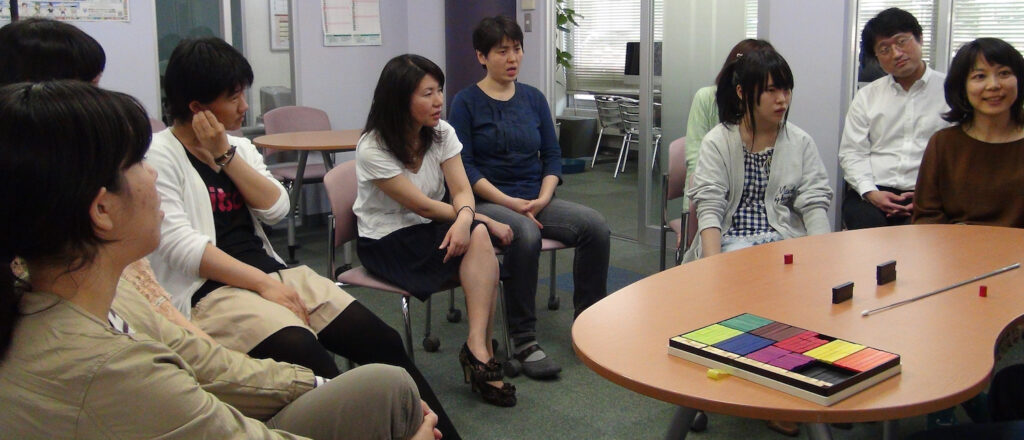
The phrase ‘off of the table’ would be a challenge for many students to say in an English way: the reduced vowel in the word ‘of’ in this context is a difficult one for them to say. In the film Pronouncing ‘off of’ (4m 6s) you’ll see how the work that the students did on the first day of the course in pronouncing reduced vowels was paying off, as the students manage to say the phrase quite well.
Then Don worked with the class on comparisons. In the film ‘A light green rod is shorter than a brown one, but …’ (4m 25s) you’ll see Don building to more complex sentences using the word ‘but’. You’ll see how Don was careful to act out the changing situation, in time with the students saying their sentence, thus reinforcing the direct connection between words and meaning. This would have concluded the final session of the third day in time for a break followed by a feedback session, however, as you’ll see in the film Students take over the lesson (4m 26s) two of the students were excited about what they had been working on and wanted to continue, and the others stayed to watch and cheer.
Don knows that to speak English fluently, something quite different from what students do at school is required: practice on the simple things. You can see an example of this in the film Consolidating what has been worked on (2m 33s)
In his teaching, Don doesn’t accept the students’ sentences until they are correct and as well-pronounced as possible. As you’ll see in the film Immediate feedback (2m 14s) his feedback is immediate, and efficient. And his way of working doesn’t discourage students.
Mistakes can be put on a spectrum running from ‘not knowing what to say’ to ‘just a slip of the tongue’. In the film ‘An orange one’ (2m 38s) you’ll see a student whose mistake was slightly more than a slip of the tongue and how the student immediately recognised the correct sentence when her colleague said it correctly, and was then able to use it herself.
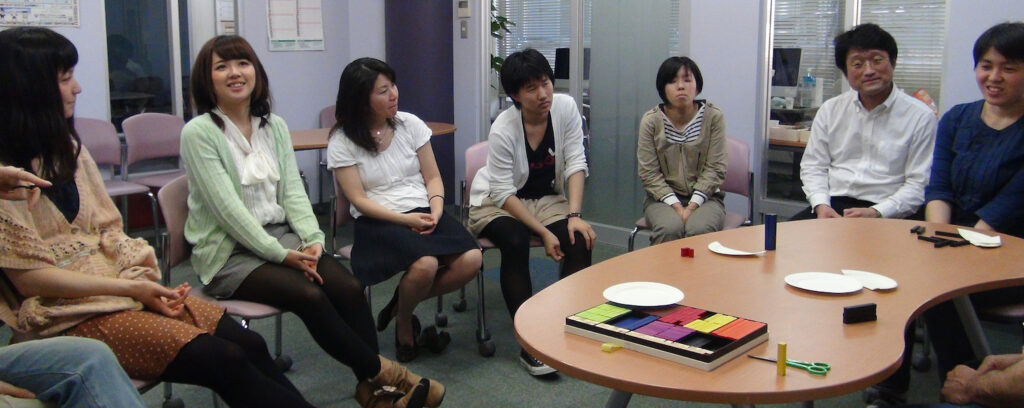
In the film ‘Two orange ones’ (1m 37s) Don used the word charts very efficiently to improve students’ pronunciation. You’ll see how rapid the process was; how he didn’t need to give any explanation; how he didn’t say the phrase himself; and how just a rapid sliding motion of his pointer on the chart was sufficient.
Then, as you can see in the film Where does ‘and’ go in a sentence? (1m 48s), Don used his hands to show the students how to chunk a sentence and then got them to practise it so that they could say it more fluently.
English intonation patterns are essential if one wants to sound English. In the film Working on intonation (2m 03s) Don worked with the students on the intonation pattern of a sentence, isolated from its words, by using whistling and gesture and then he got them to practise,
In the film Everybody is working (1m 43s) you’ll see one student working on a sentence making comparisons using words like ‘longer’ and ‘shorter’. Whilst she is working all the other students were too.
In the film Pronunciation is a physical skill (2m 30s) you’ll see the students practising the physical skills of pronunciation in just the same way that an athlete or dancer or musician would. And once the students had practised saying the sentence, Don made sure that they actually held their Cuisenaire rods so that they made a visceral connection between the reality and the sentence they were saying. And in the film How little does a teacher need to do? (1m 23s) you’ll see Don working very efficiently to enable a student to correct what she had said. And this theme of efficient correction continued in the film Comparisons: feedback and practice (2m 01s) with Don making sure that the smallest mistakes were corrected.
This session finished with Don introducing a situation which called for the students to use the phrase ‘but if …’ as you can see in the film But if … (4m 08s).
Don started the last session of the third day with more work on comparing the numbers of Cuisenaire rods each student had. He then introduced the word ‘who’. This is a difficult word for Japanese people to say because of how the nearest Japanese equivalent is pronounced. In the film Pronouncing the word ‘who’ (4m 43s), Don gave the students opportunities to try to say this word, but then, having made sure the students were fully attentive to what he was doing with his mouth, he said it just once. This is the only time in twelve hours of teaching that Don had given the students an aural model for a word.
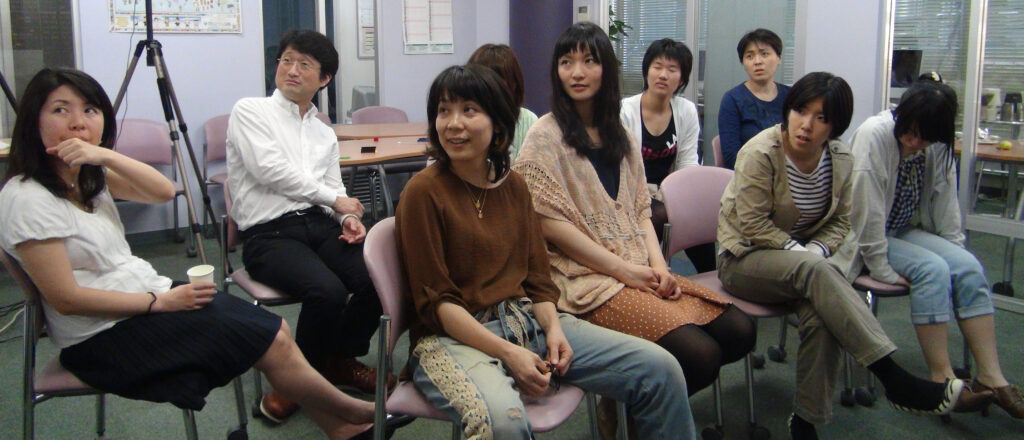
The melody of a sentence carries much of the meaning that the speaker intends. In this film, Matching the melody to the situation (2m 44s), the teacher, Don Cherry coached the students to say the sentence ‘There are more of your rods than mine’ in a way that reflected the emotion in the situation.
In the film That is correct but it isn’t true! (2m 13s) One student then tried to say the sentence ‘I have fewer rods than you’ and Don helped her get her sentence correct. But then he pointed out that what she had said wasn’t true, so she had to do some more work until her sentence was both correct and true to the situation.
With tangible objects like Cuisenaire rods, everyone is immediately certain of the truth of the situation. So the teacher can rely on people’s own perception to connect words and truth.
In the film Distributing energy in a sentence (1m 34s) one student came up with the sentence ‘She has more rods than she does’. This was both correct and true to the situation, but it didn’t sound quite English. So the teacher, Don Cherry, coached the student to place the emphasis in the right places and it started to sound much better.
It is easy in a language class for students to repeat a sentence without changing it to reflect their personal perspective—it is often necessary to change words like ‘they’ into ‘we’ etc. We see Don avoiding this danger in the film Talking from your own personal perspective (2m 30s). Since Don is trying to make sure the students associate the words they use with the reality of the situations they are talking about, it is important that he takes care that everyone talks from their own perspective.
The ability to generate alternative ways of talking about a situation is a characteristic of native speakers. Working with rods helps students become aware of these alternatives: the situation remains the same—they can see it—but they experience using different words to describe it. You can see Don working on generating alternatives in the film Alternative ways of saying something (1m 54s).
Don started the third day giving the students the opportunity to continue practising working with Cuisenaire rods. In the film ‘A word is missing—using your fingers’ (2m 10s), you’ll see Don using his fingers and giving a student the chance to find the word missing in her sentence.
Don continued responding to what the students said and did, as you can see in the film ‘Introducing the word “box”’ (3m 02s), in which one of the students needed the word ‘box’ to say what she wanted to about the situation.
Then Don invited one student to take his place at the table and the other students gave her instructions they wanted her to carry out—see the film: Practising ‘take’ and ‘put back’ (4m 57s). This allowed Don to step back into his role as ‘quality control’ on the words spoken, their pronunciation, the accuracy of the students’ instructions and of the actions that flowed from them.
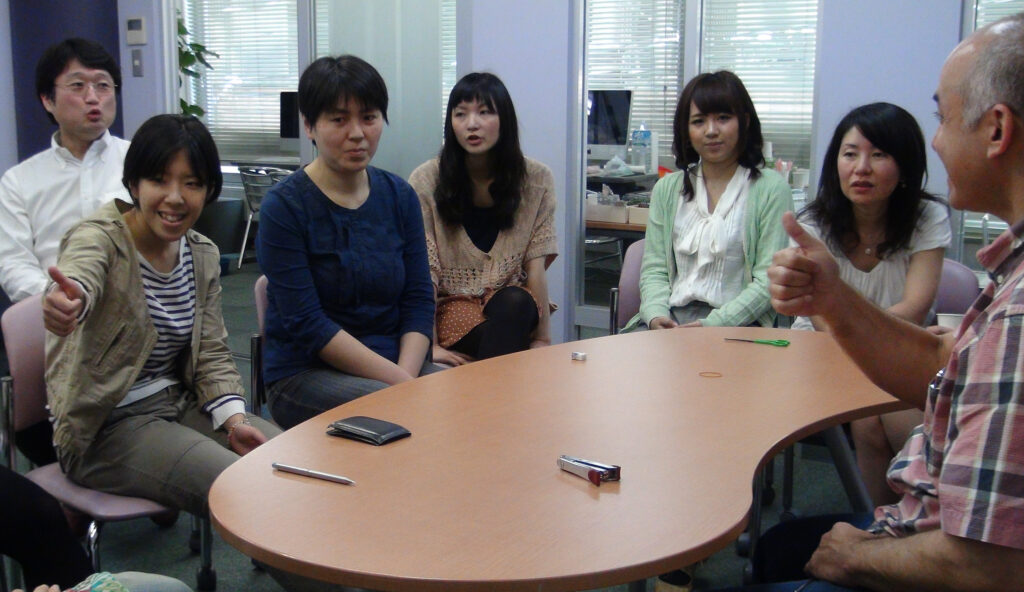
Don then got the students to play a game—Practising ‘the’ and ‘a’ (4m 25s)—to work on when ’the’ or ‘a’ was appropriate in their sentences. This is not a distinction that the Japanese language makes. To help the students make this part of English more automatic, he made the game a friendly race against the clock.
Throughout the film Provoking awarenesses (4m 20s) you will see how Don skilfully made the students aware of what they needed to say— and hear them saying ‘Ah!’ or ‘Aha!’, marking these moments of awareness. Since these are the moments when students learn, provoking them is one of a teacher’s most important jobs.
In the film ‘Chunking’ an English sentence: ‘Take one of the purple rods that are there!’ (3m 53m) Don works on every aspect of the sentence—pronunciation, grammar or meaning—helping the students say it in an English way and associate it directly with the meaning.
Don noticed that some of the students were making mistakes with the words ‘one’ and ‘ones’, so in the film The difference between ‘one’ and ‘ones’ (1m 59s), you’ll see him giving them some practice on this with a very simple situation.
Working in this way, gradually improves students’ facility with English. That’s why Don continued giving them more practise with simple, but varied situations. You’ll see this in the film Practising the language so that it starts to flow (1m 55s). In the film An efficient way of correcting (1m 27s) you’ll see how Don used Cuisenaire rods to give instant feedback, and enable the student who was talking to correct herself, rapidly. And the film ‘The group’ or ‘a member of the group’ (1m 53s) shows Don continuing to work on a part of English—using words like ‘one’, ‘another’, ‘the other’— that the students needed more practice in. And in the film ‘Or …’ (3m 16s), Don combined getting the class to generate alternatives to describe the situations they could see, with work on pronunciation.
Don then got everyone to put their hand out in a gesture which meant ‘give me’ so they could add this phrase to the range of things they were practising. Watch the film ‘Give me …’ (3m 11s) to see how Don gave the students feedback sentence by sentence on whether their sentences were grammatically correct and accurate to the reality of the situation and properly pronounced.
Intonation and sentence stress are essential parts of English, so it is important that students practise these. Watch this film—Intonation and sentence stress (2m 24s)—to see how Don coached the students to get the right intonation pattern and sentence stress for an exchange of questions.
The class continued with more practise naming a few objects: a rod, a marker, an eraser. The work the students had done on pronunciation was paying off. As you’ll see in the film Working on pronunciation details (2m 51s), they were able to improve their pronunciation with less help from Don.
In this film Describing objects on a table (3m 05s) you’ll see the students working on the apparently simple task of naming some familiar objects on the table. Despite the years of English these students have had at school, as the film shows, they nevertheless lacked the skill to produce a fluid English sentence about such a simple situation. This is why Don focused his teaching on practising this skill.
In the film Pointing on the rectangle chart as a window into students’ minds (3m 44s) two students try to point the sequence of sounds for the word ‘wallet’. Getting students to point in this way, reveals their conception of how a word should be said—if they have a mistaken idea of its sounds then their pronunciation will be poor, and we don’t want them making that incorrect pronunciation habitual through practice.
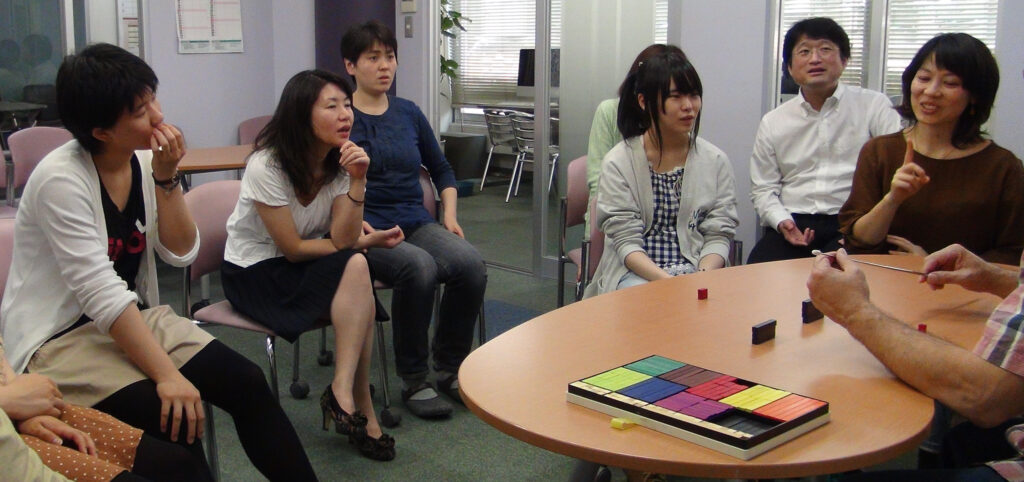
Being aware of the number of beats in an English word and where the stress should be placed is a fundamental aspect of English pronunciation. In the film Counting syllables (4m 5s) you will see Don giving the students some tools—clapping and using Cuisenaire rods—that they could use to work on this aspect of English during the rest of the course.
In the film Introducing ‘virtual words’: the word ‘on’ (4m 29s) Don introduced the word ‘on’ by pointing to its sequence of sounds on the sound-colour rectangle chart and made the phrase: ‘on a brown table’. But he wasn’t sure the students had recognised it. So he asked a couple of students to ‘write’ it on the wall. This revealed that they were confusing ‘on’ with ‘an’.
The class had been working on describing the colours of Cuisenaire rods. In the film Rising to the challenge of a long sentence (1m 52s) you’ll see one student say a sentence describing a long series of rods. The value of work like this is that students get to experience making on the fly a long sentence which corresponds to reality. And once students have developed the skills involved whilst working with rods, they can easily apply them to other situations simply by substituting other nouns and adjectives.
Don started this session slightly extending the range of language the students were working on by introducing the word ‘many’. In this film—Adding the word ‘many’ (4m 24s) you will see that, rather than using explanation or translation, Don used gesture to make the connection between the situation and the words. It is by experiencing enough clear examples of how words correspond to situations that we build up an intuitive sense of how to express ourselves in a language.
In the film, Contrasting situations (5m 36s) Don first introduced a contrasting element (‘a few’ rather than ‘a lot’) to the situation and supplied the word ‘but’, and a little later added a further contrast—how the speaker might feel about the situation: excited, disappointed or neutral.
There’s more to English than pronunciation, word choice, grammar and intonation. There is also the way we distribute energy throughout the sentence to indicate how we feel: Don wanted his students to start functioning in the way that native speakers do in this respect.
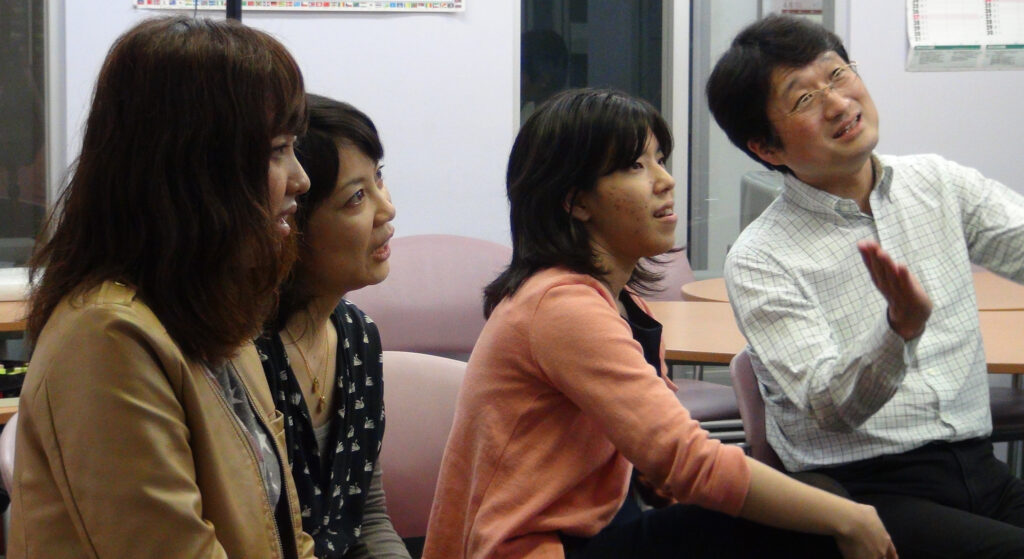
In the film ‘There are a lot there’ (7m 12s) Don worked on the tricky pronunciation details in the first three words—native speakers use the /r/ sound to join the first three words together.
This film shows an example of how working on pronunciation should be introduced at any point in a lesson whenever it is needed: pronunciation shouldn’t be worked on only in a ‘pronunciation lesson’.
The film Exploring different varieties of English (3m 15s) shows the class using the word ‘lot’ to explore the vowel sounds of different versions of English from Chicago, California, England and, by contrast, Japan. Notice how the students were able to modify how they sounded by changing the shapes they made with their mouths, simply by watching how Don, silently, moved his mouth
The fact that they could do this, at will, and without hearing anyone say these versions first, illustrates the power of the articulatory approach that Don has been taking to teaching pronunciation in this course.
Not only will this work help the students improve their pronunciation, but it will also help them get used to hearing the wide variety of vowel sounds that, unlike other languages, English tolerates.
The class continued working on giving Don instructions that they wanted him to carry out. Don would obey these if, but only if, the English was correct and appropriate to the situation.
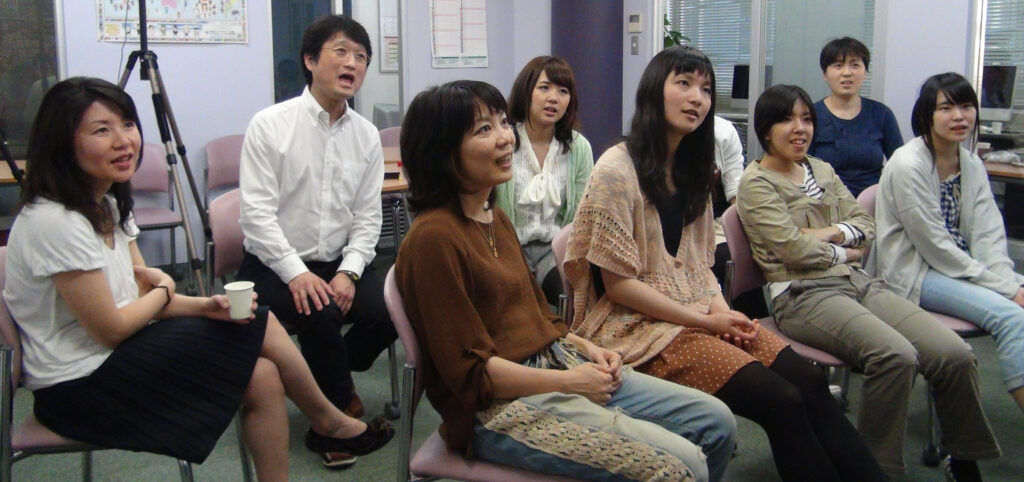
In this film—Working on emphasis (3m 21s)— you will see the students working on giving correct emphasis to their words—an important aspect of English. Don gave the students plenty of opportunity to experiment and start to learn from experience and feedback this subtle aspect of the language.
In a Silent Way class, the teacher invites experimentation and treats any resulting mistakes as ‘gifts to the class’ in Gattegno’s words, because we learn from them, if we get feedback. In this film—Speeding up (1m 28s)—you’ll see Don responding to a student’s experiment by welcoming it and giving feedback.
In this film—Changing old habits (3m 27s) you will see how Don helped a student who had the incorrect conception of the meaning of the word ‘there’ in the phrase ‘there are’—something that is common amongst students of English. You’ll see how difficult the student found it to change this habit she had formed, but how Don helped her start to break it. Once habits are formed they are very difficult to rectify, so it is far more efficient to avoid them in the first place, than to try to correct them later.
In this film—Dispelling ambiguity: ‘two’ and ’too’ (3m 8s) the students experimented until they came up with the sentence ‘There are more than two there, and there too.’ Don pointed to the sentence on the word chart, revealing that at least one student had confused the two words ‘two’ and ‘too’—also not an uncommon confusion. The word charts are very useful for revealing such confusion. Only once they are revealed can the teacher help the students to dispel them.
A simple situation with Cuisenaire rods, such as is shown in the film Generating alternatives (2m 44s), can be used to generate a lot of language. The students had been practising using phrases like ‘there are’ and ‘more than’. In this film the students practised generating alternative ways of describing what they saw. Varied practise of this sort is essential to help students make these aspects of English automatic.
Don had introduced the phrase ‘There are fewer than two there’. In the next film Changing the words as the situation changes (2m 35s), one student seemed to have got locked into these words even though the situation had changed so they were no longer appropriate. Don helped her to change her sentence to be correct and then gave her sufficient practice for her to start becoming confident with this part of English.
Don started the second day of the course by introducing a word chart: Introducing a word chart (5m 11s). The word charts contain the functional vocabulary of English – the 400 or so very common words that English uses to express spatial, temporal, numerical and personal relationships. And the words are coloured using the same colours as on the sound-colour rectangle chart to help the students with their pronunciation.
Don then used the word chart to introduce the phrase ‘end and end’ which gave a chance to work on its rhythm and the pronunciation of the word ‘and’ — said as just an /n/ sound in phrases like this. Working on English rhythm—‘end and end’ (2m 21s)
The design of the sound-colour chart, with full vowels at the top and low energy, reduced sounds at the bottom helps teaching this vital aspect of English pronunciation as you can see in the next film: Working on full vowels and reduced sounds (1m 33s).
Don continued to work on short phrases, working with the students to help them say them better. In this film — Chunking a phrase—‘an end and another end’ (2m 33s) — you’ll see him using his fingers to help them first ‘chunk’ the phrase into its components and then put the whole phrase back together.
Next Don used the word chart and the sound-colour rectangle chart to contrast two of the different sounds that the spelling <ow> have. You’ll see in this film, Two sounds with one spelling (2m 08s ), how easy it is to use the sound-colour chart to clarify this confusing aspect of English spelling.
In the next film, A red rod (2m 30s), Don introduced the phrase ‘a red rod’ and worked on its pronunciation. This is quite a difficult phrase for Japanese speakers. However, because they were building on the work the students had already done on English pronunciation, the students were able, quite quickly to say the phrase well.
Don then introduced the sentence ‘Blue is a color and red is a color too’. In the film, ‘Blue is a color and red is too’ (2m 30s), you’ll see him work on the rhythm of the phrase and then use his fingers to get the class to shorten the phrase by removing two words.
In the next film, Seeing the situation in an English way: ‘here’ and ‘there’ (4m 33s), Don worked with Cuisenaire rods, pointing and simple visible actions to help the students associate the real situation they saw developing in front of them, with the words English speakers would use. This film illustrates an important advantage of using tangible objects, like these rods — they make it easier to teach subtle distinctions, avoiding translation or explanation, so that the students experience the direct association between words and actions.
Don continued with this kind of work. The next film, One of the ways English creates emphasis (4m 34s), shows him working with the class on how English speakers emphasise the same words differently depending on what has happened before, the present situation and what the speaker wants to happen next. This kind of shifting emphasis is something students have to work on in order to express themselves properly in English, and in order to interpret the meanings that English speakers give their words by the way they emphasise them.
And in the film ‘Take one of the ones that are there and put it back’ (5m 44s) you’ll see Don helping the students say this slightly longer instruction, and see how he responded to each student’s individual difficulties, mixing together feedback, guidance and practice.
The class had been practising the order ‘Take one of the ones that are there and put it back’. Then one student decided she wanted to try something a little more elaborate. The film, Experimentation and feedback (4m 30s), shows how Don let her try, gave feedback, and encouraged her experimentation. He knew that this process of trial and error was helping her and the rest of the class refine their criteria for English.
In the final minutes of the class, Don showed the students the action he wanted to happen and then invited them to instruct him to do it. The task was to figure out the language required to get Don to do it. In the film, Using Perception (7m 04s), you’ll see Don helping the class discover and practice a number of different ways — some shorter, some longer, but all correct and accurate — of saying this order, by simply using his fingers.
Because the situation wasn’t hypothetical or imaginary, there was no need for explanation, translation or teacher talk — Don could rely on the students’ perception to supply meaning, and their mental powers to associate meaning and the language.
Don started this session by inviting the students to work on how to say their names in an English way. Each student used the sound-colour rectangle chart to show the sequence of sounds in the English version of their name and Don coached the students to say these names with English sounds, rhythm and intonation. Through this work, the students experienced changing how they use themselves, so that the sounds of their own names became quite different.
This series of five films summarises this work:
Show us your name (3m 12s)
‘Hi Ryōji!’ (3m 33s)
‘Hi Nonoko!’ (2m 09s)
‘Hi Minako’ (3m 00s)
‘Hi Machiko!’ (4m 27s)
Watching these films, you’ll notice that every student had different problems, revealed by what they did. Don responded to each student individually, by working with them on whatever they needed to improve at that moment. We call this way of teaching: ‘teaching subordinated to learning’.
This is a most efficient way of working: it doesn’t waste students’ time on things they can already do, and by working on what they can’t do, and then making sure they practise it, it ensures that they are continually inching forward.
Don then worked on the sound /f/—one that doesn’t exist in Japanese, teaching this sound by showing the students how to use their mouth differently from what they are used to for the closest Japanese sound. You see this in the film: Working on /f/ (2m 23s).
Don then invited the students to play a game where they had to guess which of two words their colleagues were saying: A game with ‘full’ and ‘fool’ (3m 39s).
And finally, Don worked on the words ‘woman’ and ‘women’, which the students weren’t sure how to pronounce, probably because of these words’ peculiar spelling: ‘Woman’ and ‘women’ (4m 03s). Using the sound-colour rectangle chart, Don was able to make clear how to say these two words, illustrating the fact that it is much better to introduce words as sequences of sounds, rather than through their written forms. The sound-colour chart makes it easy to do so.
The teacher, Don Cherry, now started to build sounds into short phrases. This meant that the class could gain experience of putting sounds together with English rhythms and melodies. At this stage Don’s focus remained on pronunciation rather than meaning, grammar or vocabulary etc.
Don doesn’t pre-plan these phrases, rather they emerge out of the progress of the class and what Don perceives they need to do more work on. You’ll see the process starting in this film when Don introduced the phrase ‘We’re learning’ (3m 23s).
In the film ‘One heart and one heart are two hearts’ (1m 50s) Don showed the class how they can work on the rhythm of their phrase by shaking hands together. The film ‘Their hearts hurt’ (3m 18s) illustrates how working with a chart and pointer, and avoiding writing, makes students ‘hold’ a phrase in their minds for a few seconds making it more likely they will retain what they’ve worked on.
The film ‘Her heart hurts’ (3m 14s) illustrates how the students retained important information about the sounds of English and how they are represented on the sound-colour chart without any effort to memorise material. This power of the mind is one that Don will exploit throughout the rest of the course.
Don realised that more work was needed on some of the phrases the class had already worked, so he revisited ‘Their hearts hurt’ and ‘Her heart hurts’ (2m 29s), keeping the students attention on the movements they need to make with their mouths to sound English.
Don completed this session by introducing the sound /ʃ/ with a gesture as you can see in this film Completing initial work on the sound-colour chart (2m 59s).
Don knew there was still more work to be done on pronunciation – skills like this cannot be mastered in just a few hours – but they now had solid foundations on which to build during the rest of the course.