
These pages will provide an analysis of a six-day intensive English course given in Tokyo, by Don Cherry, in 2012. We've provided a description of how the course developed, links to videos examining key moments and commentary on some of the underpinning rationale for the way the teacher worked
With thanks to Don Cherry for providing us with this invaluable material. To see more of his video visit his YouTube channel Don E. Cherry.
The class continued with more practise naming a few objects: a rod, a marker, an eraser. The work the students had done on pronunciation was paying off. As you’ll see in the film Working on pronunciation details (2m 51s), they were able to improve their pronunciation with less help from Don.
In this film Describing objects on a table (3m 05s) you’ll see the students working on the apparently simple task of naming some familiar objects on the table. Despite the years of English these students have had at school, as the film shows, they nevertheless lacked the skill to produce a fluid English sentence about such a simple situation. This is why Don focused his teaching on practising this skill.
In the film Pointing on the rectangle chart as a window into students’ minds (3m 44s) two students try to point the sequence of sounds for the word ‘wallet’. Getting students to point in this way, reveals their conception of how a word should be said—if they have a mistaken idea of its sounds then their pronunciation will be poor, and we don’t want them making that incorrect pronunciation habitual through practice.
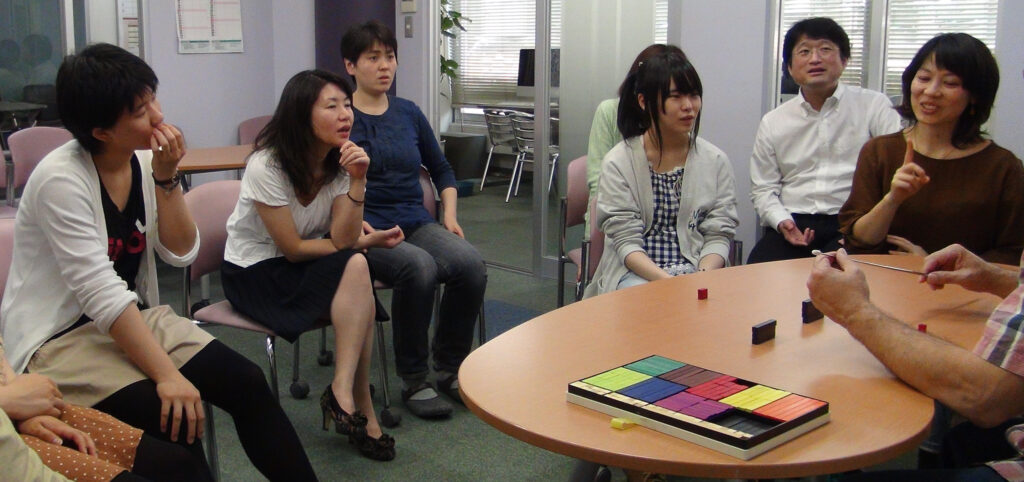
Being aware of the number of beats in an English word and where the stress should be placed is a fundamental aspect of English pronunciation. In the film Counting syllables (4m 5s) you will see Don giving the students some tools—clapping and using Cuisenaire rods—that they could use to work on this aspect of English during the rest of the course.
In the film Introducing ‘virtual words’: the word ‘on’ (4m 29s) Don introduced the word ‘on’ by pointing to its sequence of sounds on the sound-colour rectangle chart and made the phrase: ‘on a brown table’. But he wasn’t sure the students had recognised it. So he asked a couple of students to ‘write’ it on the wall. This revealed that they were confusing ‘on’ with ‘an’.
The class had been working on describing the colours of Cuisenaire rods. In the film Rising to the challenge of a long sentence (1m 52s) you’ll see one student say a sentence describing a long series of rods. The value of work like this is that students get to experience making on the fly a long sentence which corresponds to reality. And once students have developed the skills involved whilst working with rods, they can easily apply them to other situations simply by substituting other nouns and adjectives.
Check out the following articles for some of the background to what you will see in these videos.

Gesture and pointing are central to our teaching because they permit us to provide new language and to correct students’ attempts, silently and efficiently. So much of our running the class and getting students to talk and giving feedback is better done non-verbally by pointing, gesture, facial expression and mime.
Read full articlePronunciation can’t be mastered straight away. Students have to practise over a period to be able to use their muscles in new ways, and they need continuous feedback and guidance so that they gradually sound more and more native. Any part of any lesson can become a pronunciation micro-lesson: we work on pronunciation whenever it […]
Read full article