
We distinguish three types of words:
The diagram summaries how these three types of vocabulary grow for students as they progress.
(more…)Dans l’approche Silent Way, nous donnons la priorité au développement des compétences des apprenants en matière de prononciation et d’utilisation du vocabulaire fonctionnel. Il est essentiel de développer ces compétences dès le début du cours, car il s’agit des bases sur lesquelles repose tout le reste de la langue. Nous donnons également la priorité à la langue parlée sur la langue écrite.
Ces priorités signifient qu’un cours Silent Way suit un trajet très différent des autres cours de langue. Au début, nous prenons le temps de travailler sur ces bases, jusqu’à ce que les apprenants aient acquis une certaine aisance dans chaque aspect, avant de construire un nouvel apprentissage sur les compétences qu’ils possèdent maintenant.
(more…)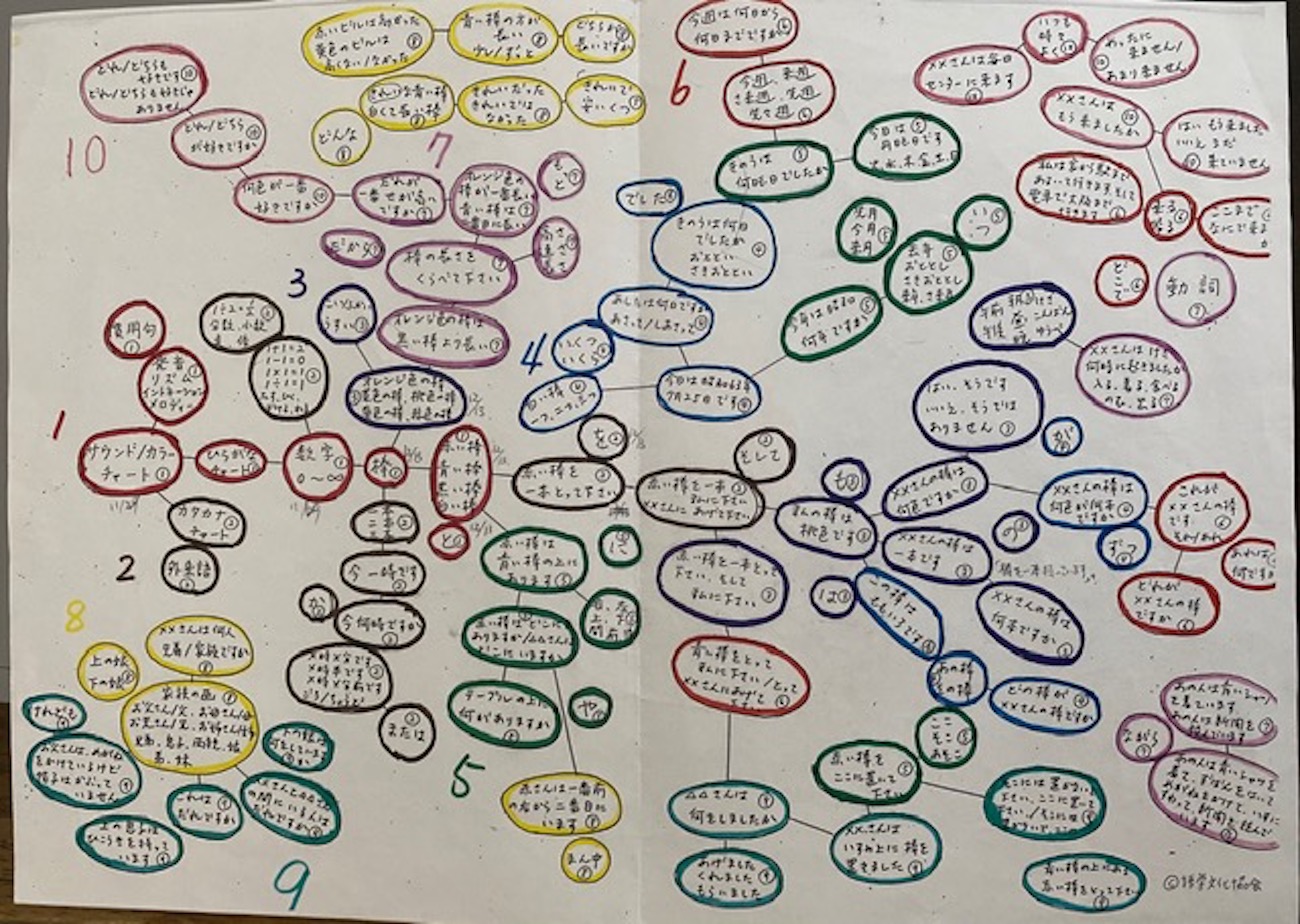
This diagram represents the Japanese language from the perspective of a teacher. Each bubble contains an aspect of Japanese and the connections show how new aspects depend on or grow from previously-worked-on ones. It also shows what a teacher would expect to work on, and give sufficient time for practice on, in a beginners course of around 60 hours.
(more…)In the Silent Way we prioritise developing students’ skills in pronunciation and in using the functional vocabulary. It’s crucial to develop facility in these things early in a course because these are the fundamentals on which everything else in the language depends. We also prioritise spoken over written language.
These priorities mean that a Silent Way course follows a very different sequence from other language courses. We take time at the beginning on these basics, working until the students have gained facility in each aspect, before building new learning on the skills they now have.
(more…)Native speakers know what ‘sounds right’ and what ‘sounds wrong’ in their language without thought and without ‘rules’. How do they acquire this certainty? Our students have to gradually build their own ‘mental models’ of the language from scratch, with all its idiosyncrasies, arbitrariness and difference from their own native language.
(more…)No one is aware of the foundations on which their native language is built, but these deep habits are built on these foundations. And these things all work in combination to make the language easy to speak for natives. So as teachers we need to uncover the foundations of the language, and then find ways of teaching them.
(more…)The first step to sounding native is sounding different. Once we make different sounds then we can pay attention to what we did different with our muscles and repeat the experience. This way we start to escape the grip of our native speech. It’s then a matter of trial and error, feedback and practice to home in on exactly what natives do.
(more…)‘What a native speaker would do’ sets the standard towards which our teaching should aim. We aspire that our students, over time, should be able to behave as native speakers would in every aspect of the foreign language —pronunciation, rhythm, grammar, intonation, vocabulary etc.
(more…)Memorisation costs us a lot of time and energy and is unreliable. We forget so easily! On the other hand, there are some things that we remember perfectly. We can recognise places; find our way back home ; get back on our skis after a break; hum a lullaby from childhood.
(more…)You can acquire a house by signing a cheque. But languages are learnt, so you have to give yourself the time and the experiences that the task requires. And you have to be ready to transform yourself: one day you know no Spanish … another day some months later you can describe what you did at the weekend in Spanish. What happened in the meantime?
(more…)