
These pages will provide an analysis of a six-day intensive English course given in Tokyo, by Don Cherry, in 2012. We've provided a description of how the course developed, links to videos examining key moments and commentary on some of the underpinning rationale for the way the teacher worked
With thanks to Don Cherry for providing us with this invaluable material. To see more of his video visit his YouTube channel Don E. Cherry.
Don started the third day giving the students the opportunity to continue practising working with Cuisenaire rods. In the film ‘A word is missing—using your fingers’ (2m 10s), you’ll see Don using his fingers and giving a student the chance to find the word missing in her sentence.
Don continued responding to what the students said and did, as you can see in the film ‘Introducing the word “box”’ (3m 02s), in which one of the students needed the word ‘box’ to say what she wanted to about the situation.
Then Don invited one student to take his place at the table and the other students gave her instructions they wanted her to carry out—see the film: Practising ‘take’ and ‘put back’ (4m 57s). This allowed Don to step back into his role as ‘quality control’ on the words spoken, their pronunciation, the accuracy of the students’ instructions and of the actions that flowed from them.
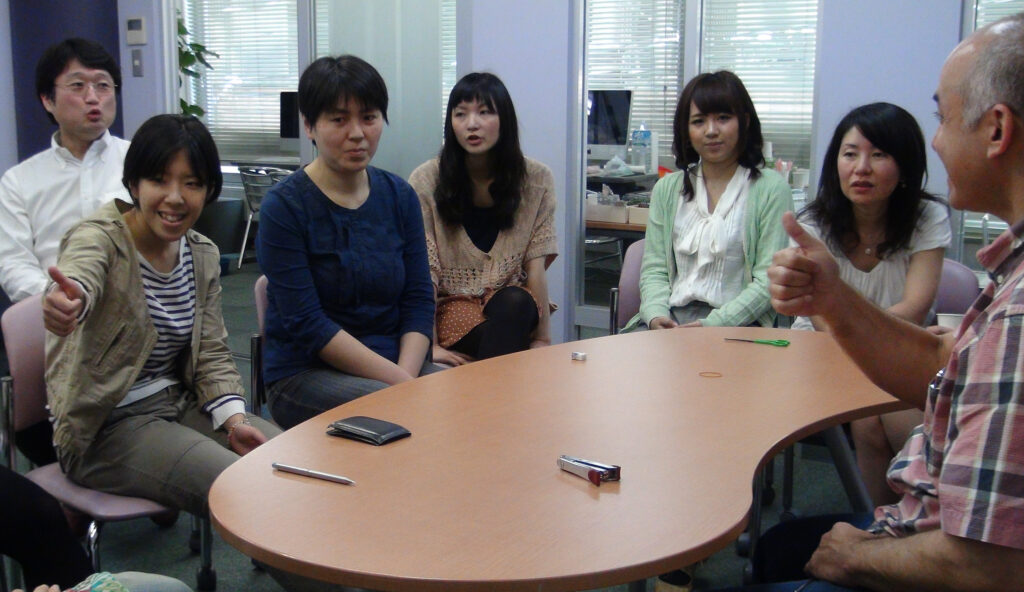
Don then got the students to play a game—Practising ‘the’ and ‘a’ (4m 25s)—to work on when ’the’ or ‘a’ was appropriate in their sentences. This is not a distinction that the Japanese language makes. To help the students make this part of English more automatic, he made the game a friendly race against the clock.
Throughout the film Provoking awarenesses (4m 20s) you will see how Don skilfully made the students aware of what they needed to say— and hear them saying ‘Ah!’ or ‘Aha!’, marking these moments of awareness. Since these are the moments when students learn, provoking them is one of a teacher’s most important jobs.
In the film ‘Chunking’ an English sentence: ‘Take one of the purple rods that are there!’ (3m 53m) Don works on every aspect of the sentence—pronunciation, grammar or meaning—helping the students say it in an English way and associate it directly with the meaning.
Don noticed that some of the students were making mistakes with the words ‘one’ and ‘ones’, so in the film The difference between ‘one’ and ‘ones’ (1m 59s), you’ll see him giving them some practice on this with a very simple situation.
Working in this way, gradually improves students’ facility with English. That’s why Don continued giving them more practise with simple, but varied situations. You’ll see this in the film Practising the language so that it starts to flow (1m 55s). In the film An efficient way of correcting (1m 27s) you’ll see how Don used Cuisenaire rods to give instant feedback, and enable the student who was talking to correct herself, rapidly. And the film ‘The group’ or ‘a member of the group’ (1m 53s) shows Don continuing to work on a part of English—using words like ‘one’, ‘another’, ‘the other’— that the students needed more practice in. And in the film ‘Or …’ (3m 16s), Don combined getting the class to generate alternatives to describe the situations they could see, with work on pronunciation.
Don then got everyone to put their hand out in a gesture which meant ‘give me’ so they could add this phrase to the range of things they were practising. Watch the film ‘Give me …’ (3m 11s) to see how Don gave the students feedback sentence by sentence on whether their sentences were grammatically correct and accurate to the reality of the situation and properly pronounced.
Intonation and sentence stress are essential parts of English, so it is important that students practise these. Watch this film—Intonation and sentence stress (2m 24s)—to see how Don coached the students to get the right intonation pattern and sentence stress for an exchange of questions.
Check out the following articles for some of the background to what you will see in these videos.

In the Silent Way of teaching the teacher keeps the students present to the task of learning the language; makes them aware of things that they need to learn; ensures that they correct their pronunciation and grammar; and keeps them moving, sentence by sentence, from the things they can do towards what they can’t yet do. While the […]
Read full article
Cuisenaire rods – small wood or plastic blocks of various colours and lengths – are very useful for teaching students how the language expresses relationships of time, space, personal relationships; and to get them to performing actions, giving instructions and making requests. Because they are easily manipulable, an infinite variety of situations can be created.
Read full article