
These pages will provide an analysis of a six-day intensive English course given in Tokyo, by Don Cherry, in 2012. We've provided a description of how the course developed, links to videos examining key moments and commentary on some of the underpinning rationale for the way the teacher worked
With thanks to Don Cherry for providing us with this invaluable material. To see more of his video visit his YouTube channel Don E. Cherry.
Don handed one student a pointer and invited the rest of the class to say any of the sounds they had been working on. The student and Don then pointed to the rectangle for the sound they heard on the sound-colour rectangle chart. This game helps refine students criteria both for how to say these sounds and what they sound like. Watch the game in the film: A game with sounds (2m 49s)
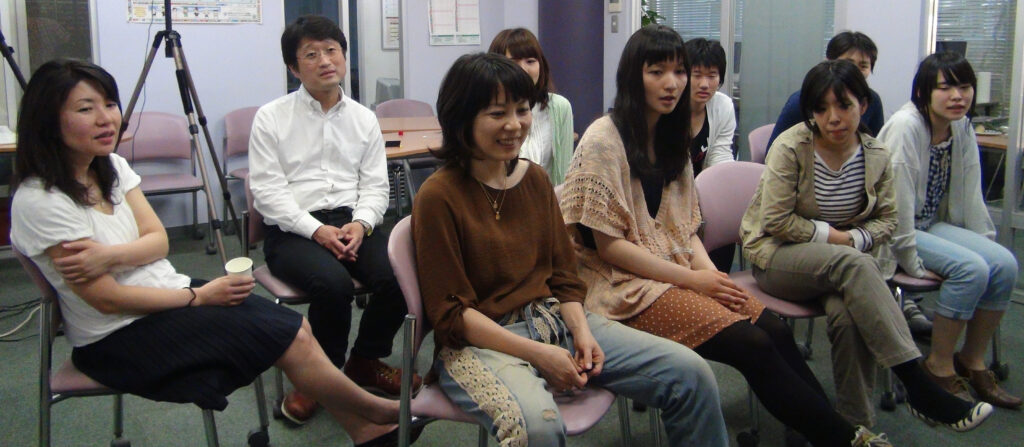
Don then reintroduced the /m/ sound—an easy sound and one they’d met before in the course—and combined it with the vowel sounds they had been working on to make syllables of three sounds like ‘mam’, ‘mem’ and ‘mum’. This was all part of the students getting used to the way that English sounds and English syllables work, as you’ll see in the film Using /m/ to work on vowels (2m 23s).
Don then introduced the four English consonants in /na/, /ta/, /da/, /la/ by showing the students the movements required to say them: Introducing four more consonants (2m 30s). And then, since he knew that plenty of practice is necessary to learn motor skills like pronunciation, he worked on these consonants, alongside ones he’d introduced earlier: Keeping practice interesting (1m 56s).
Don continued working with the students, making sure that they kept their focus on their muscles and the movements they were making – for most students this is the most efficient route to good pronunciation. See him using miming both by himself, and by the students, when working on the nonsense word /ban ban/ in this film: Focusing on movements (3m 00).
Then introduced the consonant /y/, simply saying this sound out loud once. Since it is a sound the students were used to from Japanese this wasn’t very difficult for them, but then Don immediately used the /y/ sound to work on the diphthong /aɪ/: Introducing a diphthong (1m 51s).
Don then started to work on the /r/ sound—one that Japanese speakers find particularly difficult—but, someone’s experimentation produced the /w/ sound, and Don decided to work on that instead. It often makes sense to work opportunistically with what the class comes up with spontaneously, as you can see in this film: Responding to the unexpected (3m 48s). Working with the /w/ sound had the added advantage that Don could exploit the fact they now knew how to make this sound to introduce the remaining diphthongs: More diphthongs (1m 48s)
And then Don returned to the /r/ sound, which he had put to one side to work on /w/, and worked on this until he introduced the word ‘more’ – Working on a difficult sound—/r/ (3m 8s).
And then they finished the session working on the pronunciation challenges of the phrase ‘World War II’. Don hadn’t chosen this phrase for any particular reason, it just arose naturally as a phrase with plenty of pronunciation challenges. Watch how Don worked with the students on this phrase in the film: Putting it all together (5m 44s).
Check out the following articles for some of the background to what you will see in these videos.

A telescopic metal pointer is one of the most important instruments in the teacher’s arsenal. It allows her to base her teaching consciously and deliberately on the mental powers of the students. Using the pointer with the other physical tools, the teacher can choose the precise level of her intervention—sound, word, phrase, sentence, intonation or […]
Read full article