
These pages will provide an analysis of a six-day intensive English course given in Tokyo, by Don Cherry, in 2012. We've provided a description of how the course developed, links to videos examining key moments and commentary on some of the underpinning rationale for the way the teacher worked
With thanks to Don Cherry for providing us with this invaluable material. To see more of his video visit his YouTube channel Don E. Cherry.
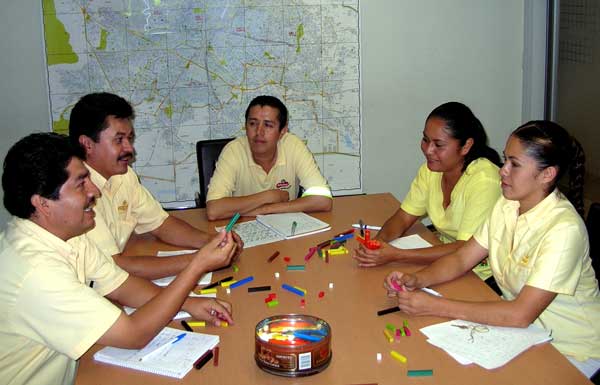
Don started this session by inviting the students to work on how to say their names in an English way. Each student used the sound-colour rectangle chart to show the sequence of sounds in the English version of their name and Don coached the students to say these names with English sounds, rhythm and intonation. Through this work, the students experienced changing how they use themselves, so that the sounds of their own names became quite different.
This series of five films summarises this work:
Show us your name (3m 12s)
‘Hi Ryōji!’ (3m 33s)
‘Hi Nonoko!’ (2m 09s)
‘Hi Minako’ (3m 00s)
‘Hi Machiko!’ (4m 27s)
Watching these films, you’ll notice that every student had different problems, revealed by what they did. Don responded to each student individually, by working with them on whatever they needed to improve at that moment. We call this way of teaching: ‘teaching subordinated to learning’.
This is a most efficient way of working: it doesn’t waste students’ time on things they can already do, and by working on what they can’t do, and then making sure they practise it, it ensures that they are continually inching forward.
Don then worked on the sound /f/—one that doesn’t exist in Japanese, teaching this sound by showing the students how to use their mouth differently from what they are used to for the closest Japanese sound. You see this in the film: Working on /f/ (2m 23s).
Don then invited the students to play a game where they had to guess which of two words their colleagues were saying: A game with ‘full’ and ‘fool’ (3m 39s).
And finally, Don worked on the words ‘woman’ and ‘women’, which the students weren’t sure how to pronounce, probably because of these words’ peculiar spelling: ‘Woman’ and ‘women’ (4m 03s). Using the sound-colour rectangle chart, Don was able to make clear how to say these two words, illustrating the fact that it is much better to introduce words as sequences of sounds, rather than through their written forms. The sound-colour chart makes it easy to do so.
Check out the following articles for some of the background to what you will see in these videos.
Once we understand what someone requires to do to learn a skill – trial & error, and practise – then what the teacher should do becomes very different. For good teaching there needs to be a fast-acting, double feedback loop in the classroom: the students learn about the language ; the teacher learns from the […]
Read full articlePronunciation can’t be mastered straight away. Students have to practise over a period to be able to use their muscles in new ways, and they need continuous feedback and guidance so that they gradually sound more and more native. Any part of any lesson can become a pronunciation micro-lesson: we work on pronunciation whenever it […]
Read full article