
These pages will provide an analysis of a six-day intensive English course given in Tokyo, by Don Cherry, in 2012. We've provided a description of how the course developed, links to videos examining key moments and commentary on some of the underpinning rationale for the way the teacher worked
With thanks to Don Cherry for providing us with this invaluable material. To see more of his video visit his YouTube channel Don E. Cherry.
Don started this session slightly extending the range of language the students were working on by introducing the word ‘many’. In this film—Adding the word ‘many’ (4m 24s) you will see that, rather than using explanation or translation, Don used gesture to make the connection between the situation and the words. It is by experiencing enough clear examples of how words correspond to situations that we build up an intuitive sense of how to express ourselves in a language.
In the film, Contrasting situations (5m 36s) Don first introduced a contrasting element (‘a few’ rather than ‘a lot’) to the situation and supplied the word ‘but’, and a little later added a further contrast—how the speaker might feel about the situation: excited, disappointed or neutral.
There’s more to English than pronunciation, word choice, grammar and intonation. There is also the way we distribute energy throughout the sentence to indicate how we feel: Don wanted his students to start functioning in the way that native speakers do in this respect.
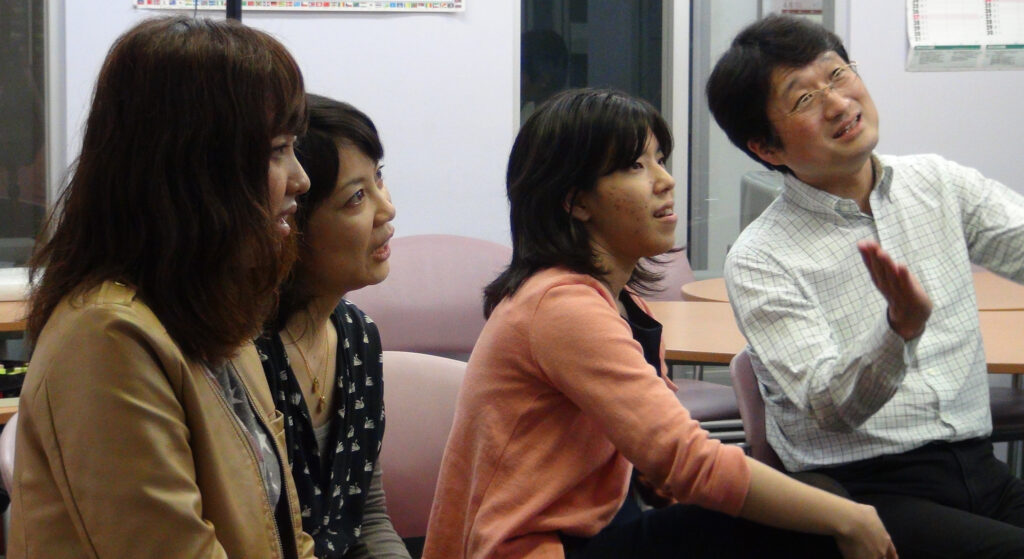
In the film ‘There are a lot there’ (7m 12s) Don worked on the tricky pronunciation details in the first three words—native speakers use the /r/ sound to join the first three words together.
This film shows an example of how working on pronunciation should be introduced at any point in a lesson whenever it is needed: pronunciation shouldn’t be worked on only in a ‘pronunciation lesson’.
The film Exploring different varieties of English (3m 15s) shows the class using the word ‘lot’ to explore the vowel sounds of different versions of English from Chicago, California, England and, by contrast, Japan. Notice how the students were able to modify how they sounded by changing the shapes they made with their mouths, simply by watching how Don, silently, moved his mouth
The fact that they could do this, at will, and without hearing anyone say these versions first, illustrates the power of the articulatory approach that Don has been taking to teaching pronunciation in this course.
Not only will this work help the students improve their pronunciation, but it will also help them get used to hearing the wide variety of vowel sounds that, unlike other languages, English tolerates.
Check out the following articles for some of the background to what you will see in these videos.

The function ‘words’ are the items which generate the grammar of a language. In English they are in fact mostly words whereas in many languages they are more often things like endings or other parts of words. They are what carries meanings for things like spatial, temporal, numerical and personal relationships.
Read full article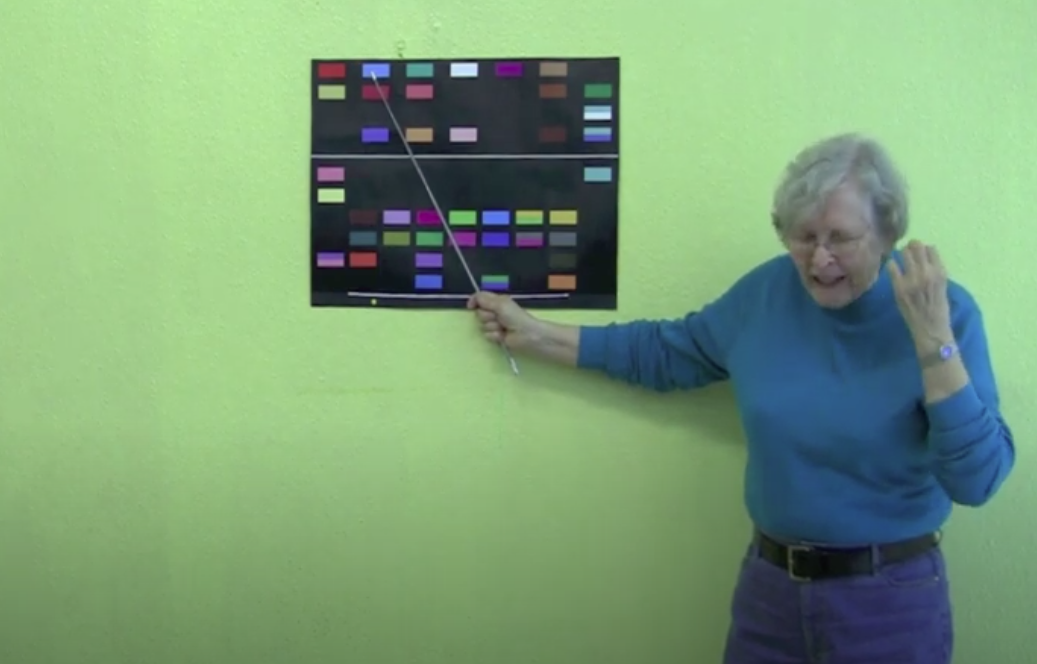
Roslyn Young teaches English students how to pronounce French vowels. A playlist of 3 videos
Read full article