
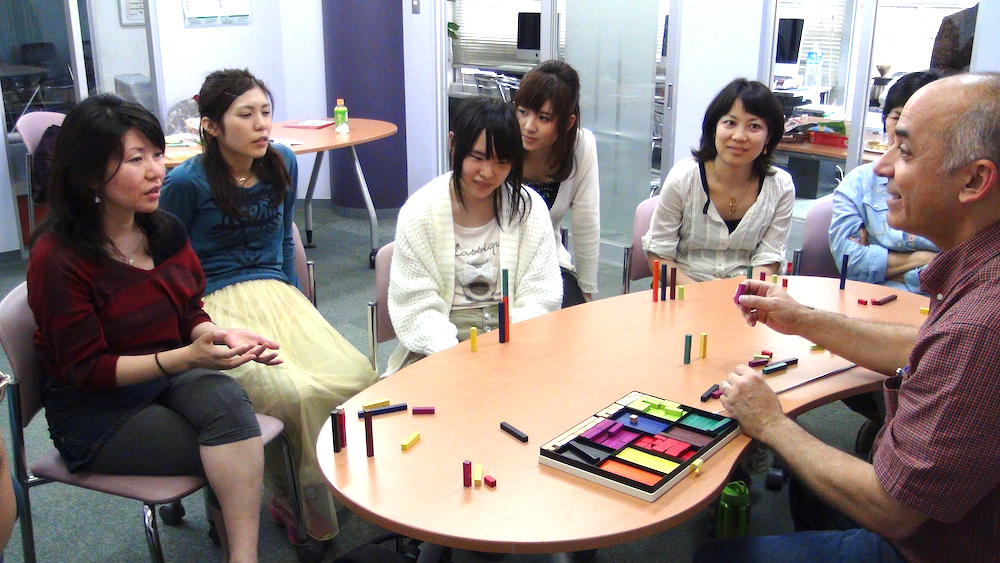
These pages will provide an analysis of a six-day intensive English course given in Tokyo, by Don Cherry, in 2012. We've provided a description of how the course developed, links to videos examining key moments and commentary on some of the underpinning rationale for the way the teacher worked
With thanks to Don Cherry for providing us with this invaluable material. To see more of his video visit his YouTube channel Don E. Cherry.
Don started the last session of the third day with more work on comparing the numbers of Cuisenaire rods each student had. He then introduced the word ‘who’. This is a difficult word for Japanese people to say because of how the nearest Japanese equivalent is pronounced. In the film Pronouncing the word ‘who’ (4m 43s), Don gave the students opportunities to try to say this word, but then, having made sure the students were fully attentive to what he was doing with his mouth, he said it just once. This is the only time in twelve hours of teaching that Don had given the students an aural model for a word.
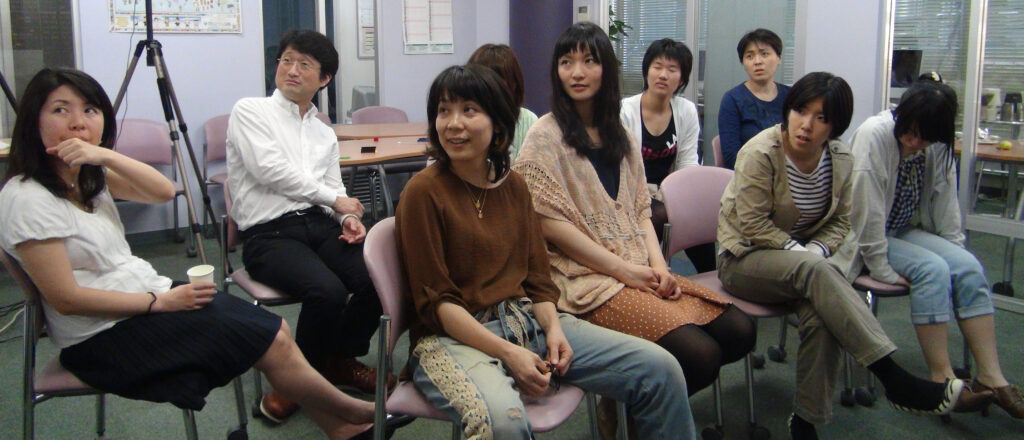
The melody of a sentence carries much of the meaning that the speaker intends. In this film, Matching the melody to the situation (2m 44s), the teacher, Don Cherry coached the students to say the sentence ‘There are more of your rods than mine’ in a way that reflected the emotion in the situation.
In the film That is correct but it isn’t true! (2m 13s) One student then tried to say the sentence ‘I have fewer rods than you’ and Don helped her get her sentence correct. But then he pointed out that what she had said wasn’t true, so she had to do some more work until her sentence was both correct and true to the situation.
With tangible objects like Cuisenaire rods, everyone is immediately certain of the truth of the situation. So the teacher can rely on people’s own perception to connect words and truth.
In the film Distributing energy in a sentence (1m 34s) one student came up with the sentence ‘She has more rods than she does’. This was both correct and true to the situation, but it didn’t sound quite English. So the teacher, Don Cherry, coached the student to place the emphasis in the right places and it started to sound much better.
It is easy in a language class for students to repeat a sentence without changing it to reflect their personal perspective—it is often necessary to change words like ‘they’ into ‘we’ etc. We see Don avoiding this danger in the film Talking from your own personal perspective (2m 30s). Since Don is trying to make sure the students associate the words they use with the reality of the situations they are talking about, it is important that he takes care that everyone talks from their own perspective.
The ability to generate alternative ways of talking about a situation is a characteristic of native speakers. Working with rods helps students become aware of these alternatives: the situation remains the same—they can see it—but they experience using different words to describe it. You can see Don working on generating alternatives in the film Alternative ways of saying something (1m 54s).
Check out the following articles for some of the background to what you will see in these videos.
The grammar of a language – how the words fit together, how the language expresses relationships of time, space, personal relationships etc – is not a matter of rules. Native-speakers simply know ‘what sounds right’. And there is no particular reason why one language uses one way of expressing these things and another a different […]
Read full article‘What a native speaker would do’ sets the standard towards which our teaching should aim. We aspire that our students, over time, should be able to behave as native speakers would in every aspect of the foreign language —pronunciation, rhythm, grammar, intonation, vocabulary etc.
Read full article