
These pages will provide an analysis of a six-day intensive English course given in Tokyo, by Don Cherry, in 2012. We've provided a description of how the course developed, links to videos examining key moments and commentary on some of the underpinning rationale for the way the teacher worked
With thanks to Don Cherry for providing us with this invaluable material. To see more of his video visit his YouTube channel Don E. Cherry.
Our native tongue is so deeply ingrained in us that it is hard to escape its grip. You can see this at work when one student found it very hard to give Don the simple instruction ‘Put a yellow rod on a light green one’. Watch the film Escaping from your native language (3m 56s) to see how Don works with the student to get her sentence correct.
The film Why do we need ‘it’? (1m 46s) shows something similar happening. You’ll see how Don used the very simple gesture of pointing to a yellow rod to enable the student to realise the function of the word ‘it’ in her sentence.
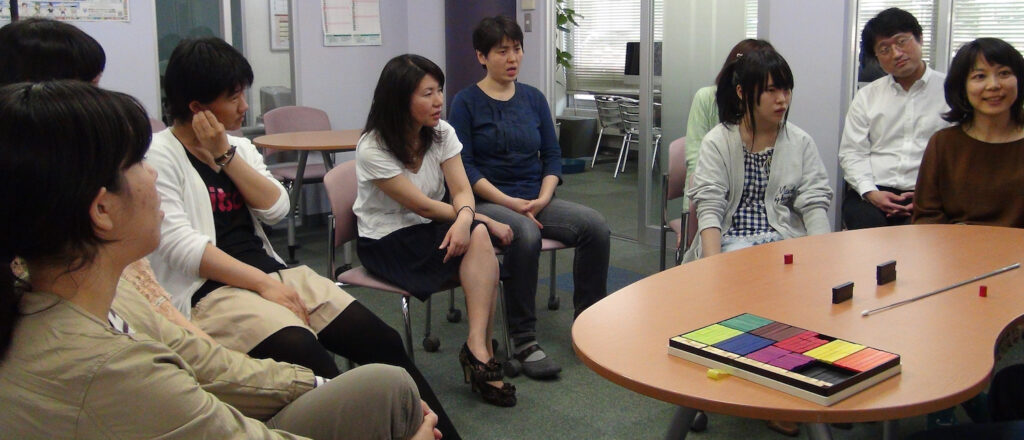
The phrase ‘off of the table’ would be a challenge for many students to say in an English way: the reduced vowel in the word ‘of’ in this context is a difficult one for them to say. In the film Pronouncing ‘off of’ (4m 6s) you’ll see how the work that the students did on the first day of the course in pronouncing reduced vowels was paying off, as the students manage to say the phrase quite well.
Then Don worked with the class on comparisons. In the film ‘A light green rod is shorter than a brown one, but …’ (4m 25s) you’ll see Don building to more complex sentences using the word ‘but’. You’ll see how Don was careful to act out the changing situation, in time with the students saying their sentence, thus reinforcing the direct connection between words and meaning. This would have concluded the final session of the third day in time for a break followed by a feedback session, however, as you’ll see in the film Students take over the lesson (4m 26s) two of the students were excited about what they had been working on and wanted to continue, and the others stayed to watch and cheer.
Check out the following articles for some of the background to what you will see in these videos.
‘What a native speaker would do’ sets the standard towards which our teaching should aim. We aspire that our students, over time, should be able to behave as native speakers would in every aspect of the foreign language —pronunciation, rhythm, grammar, intonation, vocabulary etc.
Read full article
One of the characteristics of learning is the need for the students to be present to what they are doing, to be ‘with it’. No one can learn without being focussed on the task at hand.
Read full article