TEMPORARY PAGE TO REVIEW POSTS
High priority posts for review: 8 posts
Medium priority posts for review: 13 posts
Low priority posts for review: 9 posts
High priority posts for review: 8 posts
Excerpt:
Learning to do something is a series of small steps. We start by realising that there is something to learn - something we can’t yet do. Then we experiment. Once we have worked out what we need to do we practise to achieve mastery and then what we have learnt is available for us to build other skills upon.
Full content:
Learning to do something (including, of course, learning to speak a foreign language) is a series of small steps.
Learning starts when we realise that there something we can’t yet do - something we need to learn. We experiment and gradually work out what we need to do differently to do this thing well. Then we need to practise so that whatever small thing we are currently working on becomes automatic, but once we have mastered this, then we have that skill for life and we can build other skills on top of what we have already learnt.
We can help ourselves if we:
- make sure that what we are practising really is correct and that we are using ourselves well. There is no point in practising something that is inaccurate - that merely strengthens bad habits. And depending on the skill we are working on, we need to adopt the right postures (for example see Articulatory Settings) and avoid inefficient muscular tension.
- make sure we really do master each small step - each step is a foundation for others and there is little point trying to work on the next steps if the earlier ones are still shaky
- your coach or teacher’s first job is to provoke the awareness that there is something to learn. Then they can guide your learning by helping you to experiment fruitfully and making certain that what you practise is accurate.
These four steps - awareness, experimentation, practice, use of prior learning as the foundation for learning other skills - applies to learning anything, whether it be a sport, or music, or acting, or accountancy or, of course a language.
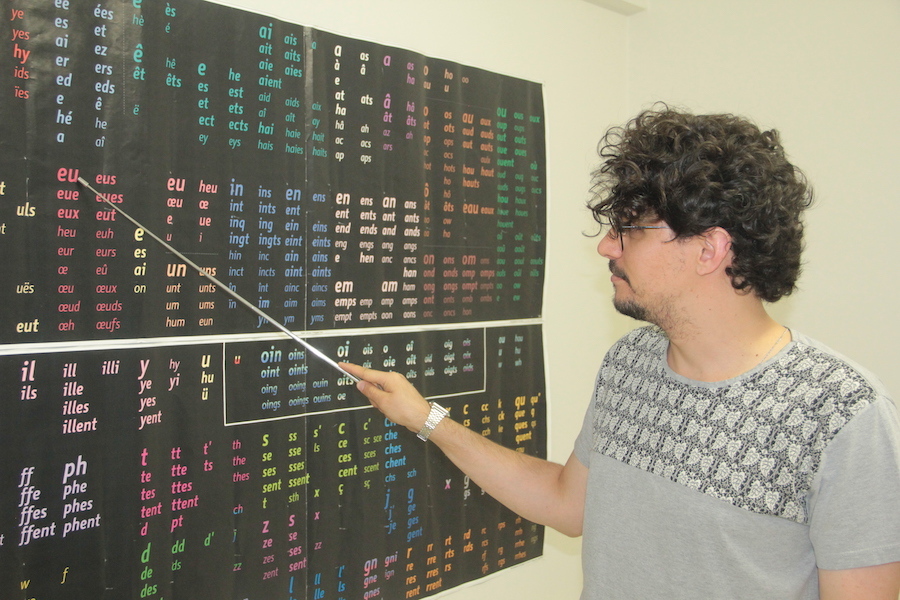
Watch this video to see the four stages of learning being used in an English class given in Tokyo in 2012 by Don Cherry:
Learning grammar through situations
Excerpt:
The grammar of a language - how the words fit together, how the language expresses relationships of time, space, personal relationships etc - is not a matter of rules. Native-speakers simply know ‘what sounds right’. And there is no particular reason why one language uses one way of expressing these things and another a different way.
Full content:
Students often ask “But why do we say X or Y?” and the only answer to such a question is that … "there is no reason: it’s just that speakers of that language have all decided collectively, over time, that that is how they speak.”
So it is much better to learn this part of language by directly associating meaning and the necessary linguistic form.
This is why we: show our classes objects, such as Cuisenaire rods, in various arrangements:
- to practise describing spatial and numerical relationships
- to get the students performing actions
- to practise how to give instructions or make requests
- and use the clock or the calendar and events the class all experienced - to practise talking about temporal relationships
- and pictures - to practise describing what we see
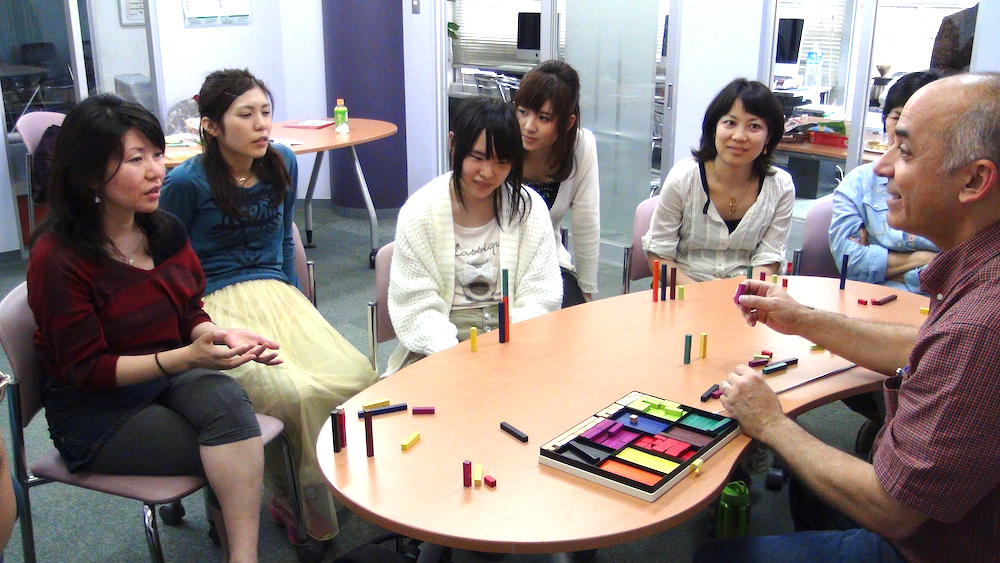
The approach is simple. We set up in front of the class an arrangement of objects, or we get the class to perform a set of actions, or we lay out a calendar in front of them, or we put a picture on the wall - all we need is something simple and clear that everyone can see and understand and which contains the meaning for which we are going to find linguistic forms.
And then, somebody from the class launches a sentence about what is in front of them. And we work on that sentence with the student and the whole class until it is true to the situation and the student’s perception of it, and correct - in other words it is something a native speaker might say if they were there. And then, it’s someone else’s turn.
And over time, the class gets familiar with how native speakers use their language to express all these kinds of things - without any need for rules or explanation or translation, since the meaning is right in front of them for all to see.
Silent Way tools – for every aspect of the language
Excerpt:
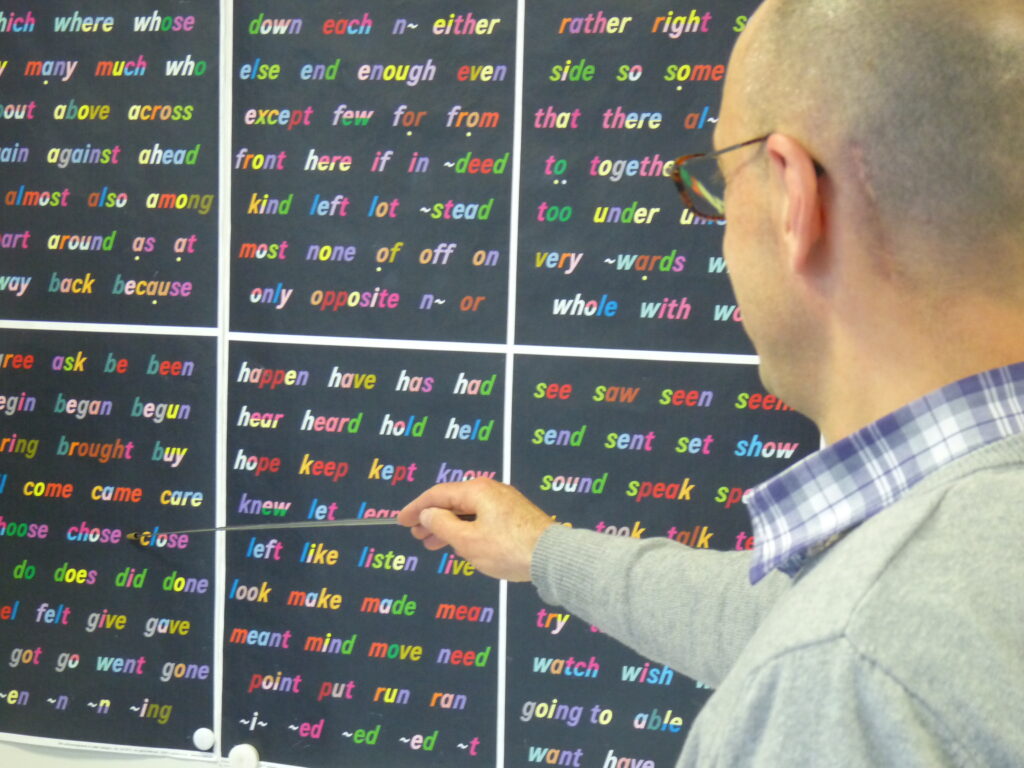
The Silent Way tools give a comprehensive view of the sounds of the language, its grammar through the function words, and the relationship between sounds and spellings. This means that these tools can be used to help the students learn how to say anything that they want to express, or to describe any situation that the teacher or the students or real life presents.
All these tools, displayed in the walls of the classroom, and referred to continually by the teacher and students using pointers, means that students get familiar with how to use all the sounds of the language and all of its grammar to express anything they want and need to.
Full content:
And, of course, if an additional piece of ‘content’ vocabulary is needed that isn’t in these resources the teacher simply provides it by ‘visually dictating’ its pronunciation or spelling on the relevant charts.
For that reason, we do not use:
- text books
- vocabulary lists
- material to work on specific grammar points eg ‘the Present Tense’, ‘the pronunciation of plural <s>’, or ‘comparatives and superlatives’
- predetermined conversations or role plays eg ‘my visit to London’, ‘my profession’, ‘climate change’
Since our goal is that students be able to express themselves in the foreign language, it is much better to free the student and the teacher to work on the needs that actually arise from the class: preset materials are unlikely to meet those needs. Indeed preset materials risk ‘subordinating learning to teaching’ - exactly the opposite of what we should be doing.
The Silent Way: the subordination of teaching to learning
Excerpt:
In the Silent Way of teaching the teacher keeps the students present to the task of learning the language; makes them aware of things that they need to learn; ensures that they correct their pronunciation and grammar; and keeps them moving, sentence by sentence, from the things they can do towards what they can’t yet do.
While the students learn the language, the teacher also learns - at every step of the way - how to teach guided by the students' potential for learning, and, by the actual learning of each individual student.
We call this way of working ‘teaching subordinated to learning’ rather than the other way round ie ‘learning subordinated to teaching’. The latter, all too common when teachers see themselves as the source of knowledge and instruction rather than the enabler of students’ learning.
Full content:
In a Silent Way class the teacher uses her time with the students in a very particular way.
What she does:
- Keeps the students present to the task of learning the language;
- makes them aware of things that they need to learn;
- ensures that they correct their pronunciation and grammar;
- ensures that the students perceive the meaning of what is being talked about without explanations
- ensures that they then practice everything sufficiently; and
- keeps them moving, sentence by sentence, from the things they can do towards what they can’t yet do.
To do these things she has to make herself sensitive to what is going on in the students moment by moment. And she has to be willing to move into the background and let their learning take over.
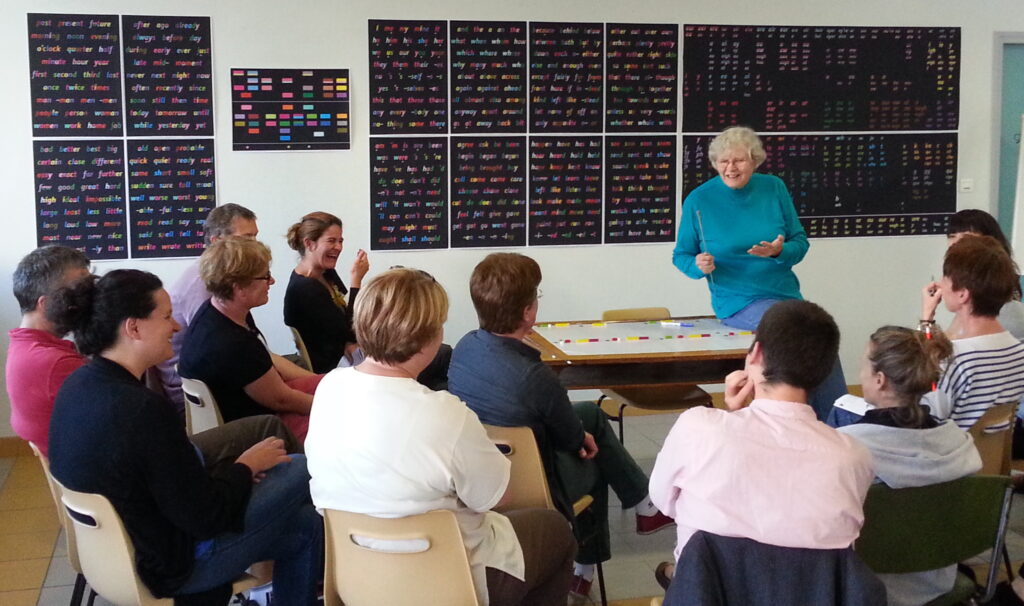
This way of teaching calls upon and activates the powers of the students in the service of their learning: their powers of awareness, will, perception, retention, intelligence - powers they call on every day.
And while the students are learning the language, the teacher is also learning. She is learning how to teach them, guided by what they do. She is constructing the lesson, moment by moment, in response to whatever needs the students reveal when they speak (see also Two-way teaching).
We call this way of working ‘teaching subordinated to learning’ rather than the other way round ie ‘learning subordinated to teaching’. The latter, all too common when teachers see themselves as the source of knowledge and instruction rather than the enabler of students’ learning.
Wall pictures – to talk about a wider range of situations
Excerpt:
A simple wall picture forms a focal point that gathers the class’ attention. The teacher and the students can point to items in the picture and practise the relevant vocabulary and create sentences about the situation they see in the picture once they have a secure foothold in pronunciation and the functional vocabulary.
Full content:
Drawings and pictures are very useful to evoke in the language classroom more situations that students can learn to talk about, once they have a secure foothold in pronunciation and the functional vocabulary.
A wall picture forms a focal point that gathers the class’ attention. The teacher and the students can point to items in the picture and practise the relevant vocabulary and create sentences about what they see in the picture. The picture is a spur for students to use their imagination to produce sentences, which use whatever vocabulary and structures they possess to make sentences which are theirs. As in all our work, the teacher works with the students, sentence-by-sentence on what they say until everything is correct, appropriate and well-pronounced.
For these purposes a good wall picture contains little detail and shows a situation that is open to different interpretations. The more detail there is in a picture, the more there is to simply name and describe, and therefore, in any lesson, the less time there will be left for the students to engage with the scene using their imagination. Such pictures tempt a teacher to give students long lists of vocabulary with which students only weakly engage.
Check out this video series to see how a teacher used an image in a class to deepend intermediate students skills in Japanese. Don't worry if you don't speak Japanese, the film has been made so that you'll still be able to see what's going.
Here are some of the pictures which Caleb Gattegno published in 1965, and some of the things a teacher might do with them.

A group of beginners might simply describe the picture. A class of intermediate students might respond to an invitation by the teacher who simply states: My bedroom is not like this. Advanced students might speculate about why the person who got out of bed didn’t put his slippers on, or anything else they might be inclined to wonder about: the choice can be left to them. If the teacher is silent for thirty seconds, someone will have something to say. (This picture is the one used in the classes illustrated in this video series.)
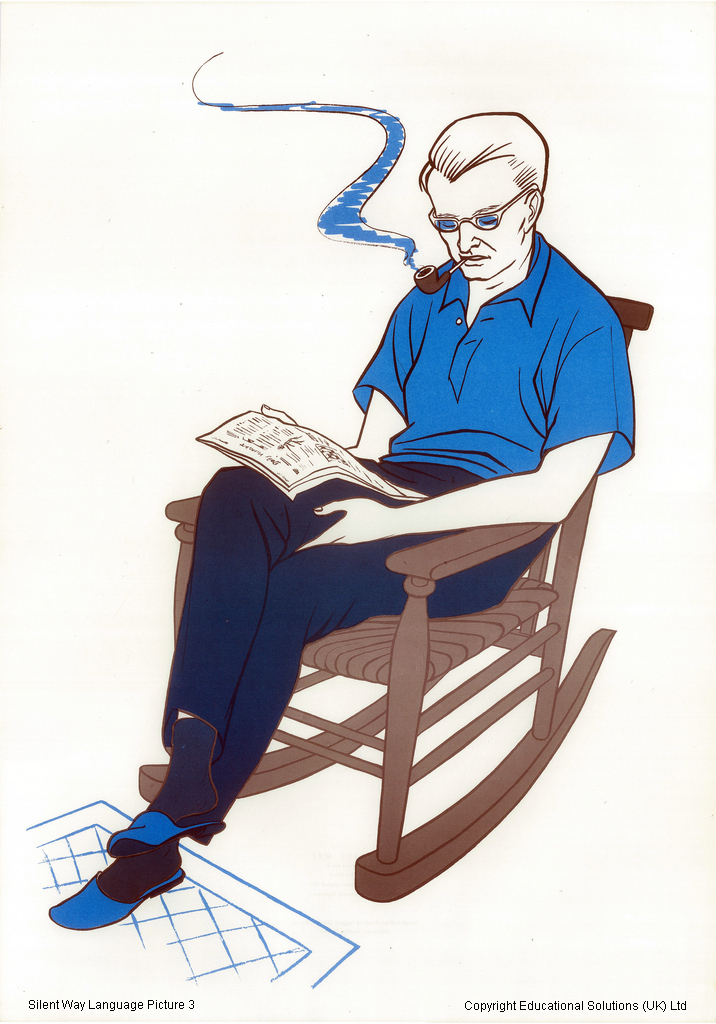
A man sitting in a rocking chair, smoking a pipe and reading a newspaper. Who is he? What do we know about him? What do we not know about him? What might we invent to say about him, beyond simply describing the scene?

A cat walking through a door. The only colour in this picture is orange. We don’t know which room the cat is leaving, nor which one it is entering. Or is it going outside? Once the objects visible in the picture have been named—there are about twenty of them—what is there to say about this scene if one is being purely descriptive? Very little, and that is the point.
This work is about the students expanding their use of the functional vocabulary across a wider range of situations. Whilst this work will also help the students get familiar with a slightly wider vocabulary, learning vocabulary is not its main purpose: the focus should remain on students expressing themselves.
Excerpt:
For foreign language beginners we start with pronunciation because the students need this skill for everything they will ever say, and because it is one of the most difficult things for them to learn on their own. We then quickly start working with Cuisenaire rods, gradually introducing new language to describe the situations we make for students.
Full content:
For foreign language beginners, we start with pronunciation, working with the sound-colour, rectangle chart. At this stage the priority is to get students experimenting, using their muscles in new ways, and finding that they can make different sounds from what they are used to. Building on this experimentation throughout the rest of the course, they can refine what they do to sound more and more native. This initial, relatively brief investment of time and energy in pronunciation is invaluable for their future as speakers of and listeners to the language.
We then quickly start working with Cuisenaire rods, gradually introducing new language to describe the situations we make for students. In this phase the word for rod is a kind of variable, like x in mathematics, which we use to show how the language ‘works’ with the most limited of vocabulary.
Quite soon students can substitute other words for x to talk freely about a wider set of real world situations, because they know how these aspects of the language function. A sentence like ‘This rod is red, but that one is blue’ lays the foundation for someone to later make up ‘This dress is beautiful, but that one is awful’ depending on whatever they want to say.
Virtually every aspect of the grammar of a language can be explored with Cuisenaire rods and the approximately 400 words of the functional vocabulary on the wall charts.
This process means that, as they complete this work, students have become used to how the language works, and can then rapidly expand their vocabulary, gradually finding themselves able to talk about anything, just by a kind of algebraic substitution, which they can invoke intuitively. And because we’ve worked on pronunciation, rhythm and melody from the start they have good pronunciation.
Silence: the most essential technique
Excerpt:
Silence puts the teacher and their students in their proper roles—they are working on the language, we are coaching them.
If we stay silent then the students have to turn their attention inward: to their muscles when they are working on pronunciation; and to their mental model of the language when they are working on words and grammar.
Silence also guards against teacher explanations and lectures, makes sure that the students do most of the talking: they are the ones who need to practice the language.
Full content:
Silence puts the teacher and their students in their proper roles—they are working on the language, we are coaching them.
If we stay silent then the students have to turn their attention inward: to their muscles when they are working on pronunciation; and to their mental model of the language when they are working on words and grammar.
Silence also guards against teacher explanations and lectures, makes sure that the students do most of the talking: they are the ones who need to practice the language.
For pronunciation, their job is to experiment with how they use their vocal equipment—lips, tongue, jaw, nose, vocal chords and breath—at first to sound different, and then to home in on sounding more native-like. Our job is to encourage that experimentation and then to give feedback on where they need to improve their pronunciation, rhythm, and melody. This can all be done with mime and gesture.
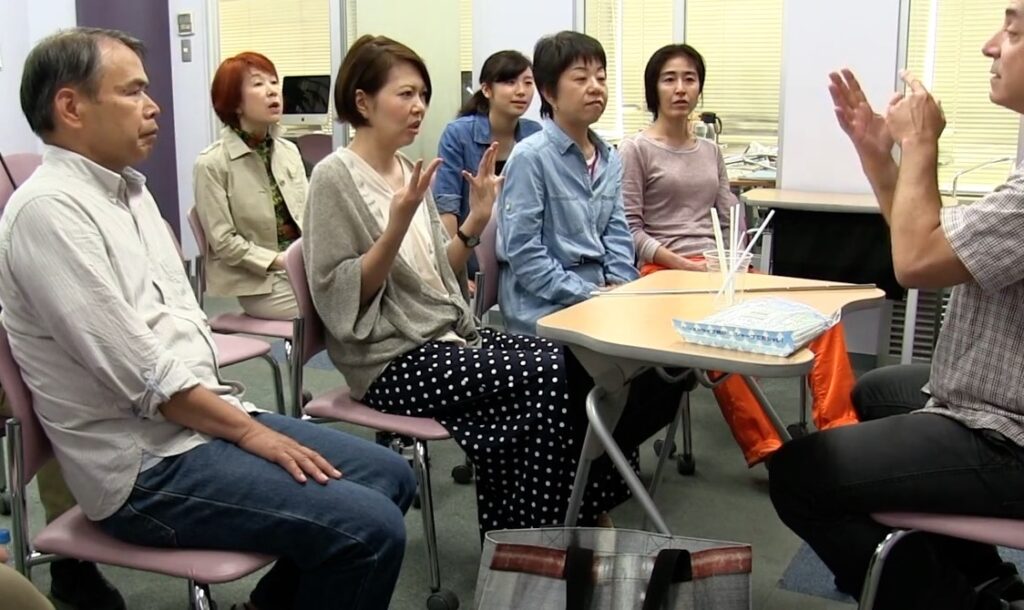
For words and grammar, if we stay silent or largely silent, they have to correct their own sentences, rather than just copying us. This is work they have to do, if they are to develop their own mental model of the language and their own criteria for correctness and accuracy. Our job is to guide them in this work with precise feedback.
Awareness: the atom of learning
Excerpt:
Learning starts with someone becoming aware that there is something to learn, or change, or improve: that there is a difference between their performance and what they are aspiring to, or could aspire to.
It is these tiny moments of awareness that kickstart the process of learning. Without these moments of awareness there is no reason or drive for anyone to do the work required. It is the teacher’s job to provoke these awarenesses in his/her students: they are the necessary requirement for learning to take place. Once students have noticed that there is something to learn, then the teacher’s job becomes slightly different: to encourage and guide such experimentation and then provide precise feedback.
Full content:
Learning starts with someone becoming aware that there is something to learn, or change, or improve: that there is a difference between their performance and what they are aspiring to or could aspire to.
It is these tiny moments of awareness that kickstart, or provide the energy for the process of learning. Without these moments of awareness there is no reason or drive for anyone to do the work required. It is the teacher’s job to provoke these awarenesses in his/her students: they are the necessary requirement for learning to take place.
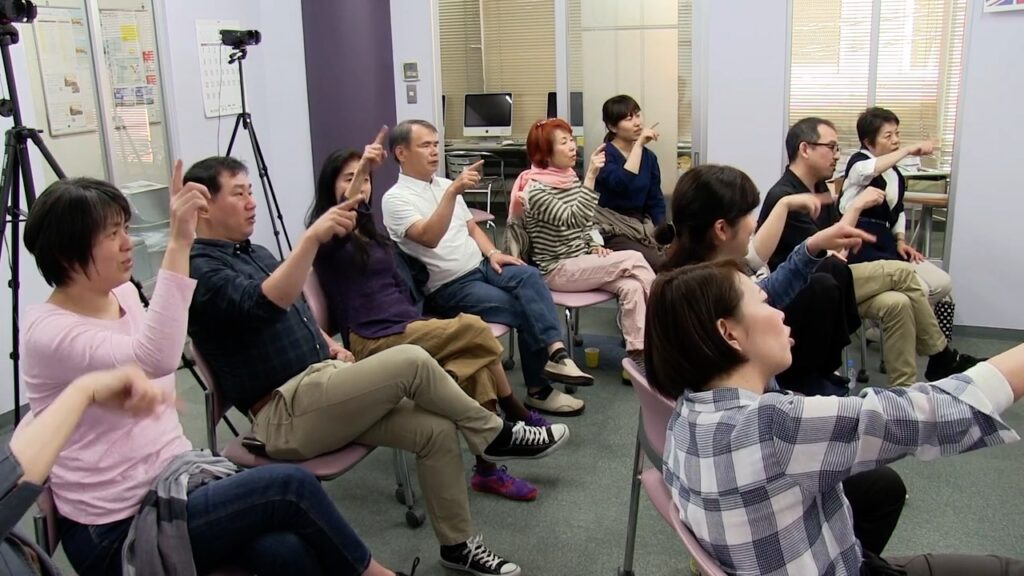
Once students have noticed that there is something to learn, then they need to experiment and try to be different – and at this stage the teacher’s job becomes a slightly different one: to encourage and guide such experimentation and then provide precise feedback. The student’s learning feeds on such feedback enabling him to hone his performance.
And once some improvement has been made then the student needs to practice, so that the change in how they function is consolidated and made automatic. The teacher’s job at this stage is to insist on, guide and support such practice.
This kind of learning isn’t a linear process. The student takes detours, and, frequently, something apparently solved today, reappears as being less secure tomorrow. But if the student persists, it becomes a spiral with further learning building on previous learning and progressively greater levels of mastery.
Medium priority posts for review: 13 posts
A pointer – to keep students present and mentally active
Excerpt:
A telescopic metal pointer is one of the most important instruments in the teacher’s arsenal. It allows her to base her teaching consciously and deliberately on the mental powers of the students. Using the pointer with the other physical tools, the teacher can choose the precise level of her intervention—sound, word, phrase, sentence, intonation or melody—and link these together into a coherent whole.
Full content:

The pointer allows her to show the students how to create the particular dynamics of the language being learned while they are constructing their sentences. The ‘dynamics of a language’ include the rhythms, the intonation and the grouping of words as well as the tones in the case of a tone language.
The fact that the pointer passes from word to word on the word charts leaving no visible trace reflects the fact that language is ephemeral. Pointing quickly leads to greater retention, since the students must invest themselves to retain the words as they appear and disappear from view. This is not the case when the teacher writes on the board.
This dynamic element will often be different for the same string of words depending on the context or the situation created by the teacher or the students. The students must produce not just the words, but the language as it is spoken in the context of whatever specific exchange that is taking place, here and now, as part of the class conversation.
Pointing allows the teacher to keep the students present. They have to actively notice what is taking place because as soon as the pointer leaves a word, the word disappears unless the students mentally note which words have been touched and in what order. They can never flick back a few pages to find a phrase which has been forgotten or to refresh their memories. This has the effect of greatly enhancing retention.
The teacher is thus equipped to mobilise her students. For the whole time the class takes place, and whatever the level of the students, they have to work, using their mental powers and in particular, their capacity to evoke. Their job consists of constructing links in their minds between the situations presented and the language used to talk about them.
Watch this video to find out more about using a pointer and charts.
A rectangle chart – to teach sounds
Excerpt:
Every language has its own repertoire of sounds. If students are to learn good pronunciation they need to know how to produce the full set of sounds that that language uses. And since students will potentially encounter any of these sounds in any word or sentence they come across, working on all these sounds early on in a course is a good idea. Doing this work early reduces the risk of students building bad habits of pronunciation.
Full content:

So a Silent Way course normally starts with the teacher placing on the wall a chart showing all the sounds of the language. Coloured rectangles represent each sound. And the sounds are organised in a way that shows how the sounds relate to each other–conveniently grouping together sounds made with similar actions of the lips, mouth, vocal chords etc. The teacher will normally display this chart on the wall in the classroom for every lesson throughout the course.
The teacher will use the chart to enable the students to experiment with making the sounds of the language and gradually achieving greater and greater accuracy. This work will stand the students in good stead for all that is to follow in learning that language.
Using this teaching tool means that:
- students can always see a glance complete inventory of the sounds of the language
- students, gradually, and without needing to memorise anything, get familiar with what they need to do to make all these sounds
- the teacher can avoid introducing letters and spelling, with all the pitfalls for pronunciation these entail for most languages
- any time the teacher or students need to refer unambiguously to a sound, this chart is immediately available: they just need to point to the relevant rectangle

There are, of course, other types of phonemic charts, for example, ones using the International Phonetic Alphabet.
The Silent Way sound-colour chart has the advantage that students don’t need to learn an ‘artificial’ script such as IPA and the colours can be used on other charts to help the student master how to pronounce and spell any words in the language (see Word Charts, Spelling Chart).
These charts can also have additional features, if the language requires them: for example, the Silent Way sound-colour chart for English enables the teacher to show schwa sounds and the levels of stress within a word or phrase.
The film below gives just one example of the sound-colour rectangle chart in use in the early moments of a six-day intensive English course, given in Tokyo in 2012 by Don Cherry.
But, pronouncing a language well is more than just making the right series of sounds. As Gattegno said, the 'music' of a language 'includes the silences, the pauses, the flow, the linkages of words, the duration of each breath required to utter connected chunks of the language, the overtone and undertones, the stresses as well as the special vowels or consonants belonging to that language.' Gattegno C. (1963, reprinted 2010) Teaching Foreign Languages in Schools, Education Solutions Worldwide Inc, p.37)
A spelling chart – to relate sounds to spellings
Excerpt:
The spelling chart shows the relationship between sounds and spellings using the same colours as on the sound-colour chart. For most languages this relationship is not straightforward, and this is particularly so for a language like English. Teacher and students can explore this relationship by pointing on the chart. That way students gradually get familiar with the patterns.
Full content:
In some languages there is a reasonably close relationship between sounds and spelling. But even for languages like this, the relationship between letters and sounds will probably not be the same as for your native language.
A simple example: in Spanish the letters <b> <v> both can represent one of two sounds. Neither of these two sounds are the same as those these letters stand for in English. And, of course, for many languages, the relationship between sounds and spellings is more complicated.

The spelling chart directly addresses this problem because it maps all the possible spellings for each sound onto the colour of that sound. Once the students know the associations of sounds to colours—and they will have worked on these during the initial work in a course on learning how to pronounce these sounds—they have a direct route into the language's patterns of spelling. This is especially useful in languages like English and French where the number of spellings for each sound can be considerable.

Once the teacher has introduced the spelling chart and shown the class how it relates to the sound-colour chart, then simply through pointing to the relevant entries the students will gradually become familiar with the relationships between letters and sounds that the language happens to use.
Watch this video to see two students building a spelling chart as part of their beginners Catalan course:
Cuisenaire rods – to teach grammar through situations
Excerpt:
Cuisenaire rods - small wood or plastic blocks of various colours and lengths - are very useful for teaching students how the language expresses relationships of time, space, personal relationships; and to get them to performing actions, giving instructions and making requests.
Because they are easily manipulable, an infinite variety of situations can be created.
Full content:
Cuisenaire rods - small wood or plastic blocks of various colours and lengths - are very useful for teaching students how the language expresses relationships of time, space, personal relationships; and to get them to performing actions, giving instructions and making requests.

We start by setting out some rods in front of the students and working on sentences to describe what they can perceive. To start with the sentences will be very simple: ‘A red rod’ ’Two red rods’ but will gradually get more elaborate ‘A red rod and a green one’, ‘A red rod on top of a black one’, ’Two rods side by side’.
And then we can add instructions such as ‘Take a blue rod and put it here’, or other aspects of grammar ‘My rod is orange’ or ‘I took a green rod and gave it to her’.
Because they are easily manipulable, an infinite variety of situations can be created. And because they are tangible and visible to everyone, there is no doubt about the meaning of the language being created about them. But without any need for verbal explanations: everyone’s perception alone is sufficient.
And all of this work means the students gradually become familiar with how the language works, and what different shades of meaning are implied by different words and word forms. In fact it is possible to work on just about every aspect of the grammar of a language simply working with the function words and using this approach.
And this way of working has a major advantage: the memory burden on the students is kept very low, even though they can still generate ‘much language’.
And because they are mastering how to use the functional vocabulary of the language, thereafter they can easily extend what they can say by a kind of algebraic substitution. The word for rod becomes a kind of variable, like x in mathematics, and soon students can substitute other words for x, to talk freely about a wider set of real-world situations. A sentence like ‘This rod is red, but that one is blue’ lays the foundation for someone to later make up ‘This dress is beautiful, but that one is awful’ depending on whatever they want to say.
Excerpt:
It’s always better, at every level, to learn together with other students and practice the whole process of expressing yourself in a foreign language: from your thoughts through to using your muscles to make the foreign sounds of foreign words in the foreign sentences you need to express your idea. And everyone learns from everyone else in the class: a mistake is a gift to the class.
Full content:
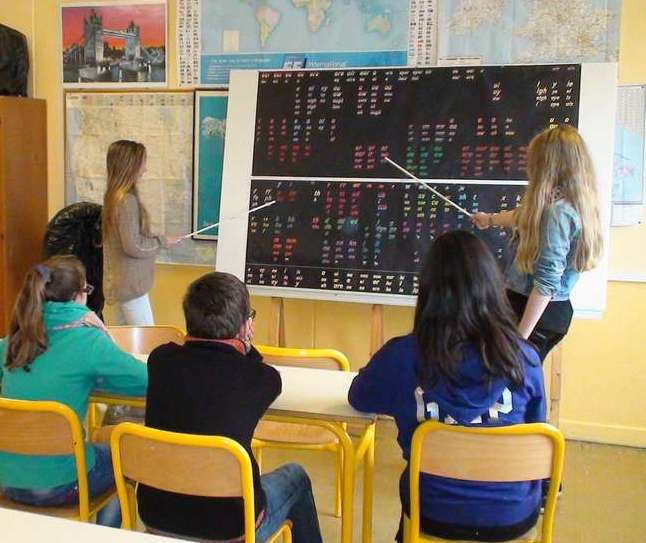
Learning a language together in a group is far more effective than learning solo. Here’s some reasons why:
- Language isn’t an abstract or artificial game with ‘rules’ and ‘points’ for correct answers, it’s the principal way that humans express their thoughts, feelings, perceptions, instructions, ideas and opinions and share them with others. So it’s always better, at every level, to learn together with other students and practice the whole process: from your thoughts through to using your muscles to make the foreign sounds of foreign words in the foreign sentences you need to express your idea. Learning this way means you’ll be ready, quicker, for all those spontaneous real-life encounters that your new language is for.
- Whilst someone else in the class is working on a sentence, you can work along with them too. If you’re already fairly confident of how the sentence should go, then observing someone else working will help strengthen and reform your internal criteria. If you have no idea about what needs correcting then you’ll gain new awarenesses from observing.
- A group gives a chance to work, authentically, on every aspect of the language. For example, situations requiring sentences like ‘Give them x!’ or ‘Take his chair and put it with theirs’ etc are inevitably contrived if you are learning on your own.
- When the focus of the class moves to another person, you have the chance to process what’s just happened or is happening. You can take a breather or a rest, whilst you work on the experience internally and subconsciously.
- Other members of a group can help the student who’s the current focus of the lesson, so teachers can stay more in their proper role as coach to the whole class. Otherwise teachers risk becoming perceived as the sole authoritative source of correct answers.
- And watching others, whose perspectives, strengths and weaknesses are different from yours, as they experiment, try things out and gain new skills, will give you insights and inspiration you could never get on your own.
In fact, larger groups are nearly always preferable to smaller groups: we all learn more together, more efficiently and more effectively.
Excerpt:
If we are genuinely working at the edge of students' knowhow, all the time - in the margin between what they can do pretty competently and what they really aren’t ready for yet - then we can’t possibly plan our lesson in any detail in advance. We only know where that margin is, in the moment, by noticing what they do well and what their errors are. So we need moment by moment planning.
Full content:
And if we aren’t working in this space then we are working inefficiently: either boring them, or wasting their time and energy with things they can already do; or talking about things beyond what they are yet capable of tackling. We need moment by moment planning.
So we never go into a class with a detailed plan. We may have an idea of the broad direction that we should take and which parts of the language the class should be expanding into, but this can only ever be a provisional idea, and we only know what to do in the next moment, in response to what the students did in the last one. Becoming a great teacher means becoming a great improviser.
That means rather than preparing our class we must prepare ourselves. So that we are ready to respond to whatever comes. And the best way to do that is to ‘post-prepare’ - that is to reflect after each lesson on what happened; which opportunities to provoke awarenesses we seized and which we fumbled; invent new possible techniques and solutions; build hypotheses about what different students might need. Even better is to share these reflections with colleagues and listen to their own reflections.
And we need to keep our focus on what is our proper role as teachers, which is to work on the people in our classes, so that they, in turn, can work on the language.
As Caleb Gattegno said
‘I’m a teacher of people not a teacher of language.’
Caleb Gattegno
Much language with little vocabulary
Excerpt:
We focus on teaching our students how to use the functional vocabulary of a language. With a tiny vocabulary of not much more than 400 words (at least for a language like English) we can explore every aspect of pronunciation and virtually all the grammar of language. Once they have mastered how the language ‘works’ then they can pick up whatever else they need by use and exposure.
Full content:
No one knows all the vocabulary of a language - not even any native. Of course, you do need a reasonable vocabulary to comfortably speak a language, but is this the aspect of language that we, as teachers, should be focusing our time on in class?
The difficult bits of learning a language are things like pronunciation and melody, how the ‘little words’ work idiomatically, how the language expresses temporal or personal relationships, how the language expresses doubt or compulsion or uncertainty. These are the subtle parts of a language that it is hard for students to learn by themselves. But once the students have these aspects of the language and can start to use it comfortably, then picking up the vocabulary that they need, for whatever they want to do with it in their life, suddenly becomes easier - and they can simply acquire more and more words just the way we do in our native language. As natives, we do it all the time: when we move to a new job, or change profession or take up a new hobby or become part of a different milieu we suddenly find ourself at ease with new words, the jargon of our new employer or work colleagues, or the specialist words of whatever is our new interest, or the current slang in our social group.
This is a natural process: once we have mastered how the language ‘works’ then we can pick up whatever else we need by use and exposure. But until we have such mastery, picking vocabulary up is impossible or at least, very hard work.
So that’s why we focus on teaching our students how to use the functional vocabulary of a language. With a tiny vocabulary of not much more than 400 words (at least for a language like English) we can explore every aspect of pronunciation and virtually all the grammar of language and give our students the right foundation for them to expand the range of their language for whatever they want and need.
Silence – to put the teacher and their students in their proper roles
Excerpt:
If the teacher is silent (though she is not mute), she neither models pronunciation, nor tells the student what to say. Rather, she coaches them toward the correct use of the language. Silence means the teacher can easily keep the students at the frontier between what they have mastered and what they don’t yet know. Silence puts the teacher and their students in their proper roles—they are working on the language, we are coaching them.
Full content:
One of the hallmarks of the Silent Way is that the teacher is silent. She is not mute, but she neither models pronunciation, nor tells the student what to say. Rather, she coaches them toward the correct use of the language.
The teacher’s silence is a constant reminder that her role is not to transmit knowledge. Whatever the field, nothing allows us to suppose that having knowledge contributes to creating know-hows. Just as reading a book called The piano in ten easy lessons would not allow the reader to become a pianist, so learning grammar rules does not create proficiency in speaking. Only practice will allow that.
Becoming silent requires of the teacher that she reflect constantly on her own clarity. If she works too quickly her class, especially if it is a class of beginners or low level students, is plunged into silence and she knows immediately that she has lost her students. They cannot equate the language used with the situation created. This means that she is never tempted to stray further ahead than her class; an excellent safeguard.
However, perhaps the most important use of silence is that it allows the teacher to keep the students at the frontier between what they have mastered and what they don’t yet know. Every time they speak—and since the teacher is silent, they speak most of the time— what they can say is what they already know and what they can’t is what there is to be learned right now. No time is wasted on lessons given by the teacher when she doesn’t really know who needs what she is telling them.
Silence puts the teacher and their students in their proper roles—they are working on the language, we are coaching them. Watch this video to see something of this in practice.
Excerpt:
If we teach silently then the students are the ones responsible for doing the work. Silence frees the teacher to better observe the students. And if the teacher stays silent then the students can't try to copy the short-lived memory of a sequence of sounds without really working to 'own' the unfamiliar actions required. But silence doesn't mean the teacher says absolutely nothing.
Full content:
1. Who’s supposed to be practising in a language class? So who should do most of the talking? The students? Or the teacher?
2. When you correct a word, phrase or sentence by simply saying it back to the class correctly, how are they to know exactly where the error was? Or what they should have done differently? All you’ve done is to give them the answer: what inner criteria have you helped them develop?
3. Since students’ listening to a foreign language is unreliable, why would you think listening to teacher speech would be a solid foundation for their learning?
4. The more you talk, the more you are part of a conversation with the class. Is that your role? Shouldn’t you be a coach or quality controller or source of feedback? Can you fulfil that role if you are also a participant?
5. Does copying the teacher usually (ever?) permit someone who couldn’t already do it, to make a French <r> or a Spanish <rr> or an English <r>?
6. We’re teaching people, not robots or copying machines. How will our students become independent of us if most of the time all we ask them to do is copy us?
7. The students’ ears might be unreliable, but yours aren’t. The less you talk, the more you’ll hear. Only you can provide the feedback students need if they are to learn to sound native. How will you provide that if you talk more than you listen?
8. Can you stop yourself? Once you start talking aren’t you likely to carry on? Add an explanation here, an aside there, a favourite anecdote or quotation ... and all in the foreign language your students hardly know? Is that really what you are there for?
9. Watching a dancer or a skater or a musician might inspire you to take up these arts, but it won’t tell you where to put your feet, or how to balance your limbs or where to put your fingers. You can only learn these things by doing and finding out what happens. Isn’t it the same for any skill? So why should listening to speech tell us what to do with our breath, vocal cords, tongue, jaw, and lips?
10. There is an alternative: the students have to try, make mistakes, try again, and pay attention. And you the teacher have to give precise feedback and steer them towards native-like behaviour and then help them get enough practice. And you can do this silently, without giving them the answer, using mime, gesture, pointing, and facial expression etc.
Excerpt:
Once we understand what someone requires to do to learn a skill - trial & error, and practise - then what the teacher should do becomes very different. For good teaching there needs to be a fast-acting, double feedback loop in the classroom: the students learn about the language ; the teacher learns from the students.
Full content:
Once we understand what someone requires to do to learn a skill - trial & error, and practise - and design this into our pedagogy, then what the teacher does becomes very different.
In the case of language, the student learns by trial and error, by deliberate experimentation and by practise. But since he cannot have accurate criteria for the foreign language at the start - in the early stages, he is certain to mislead himself by relying on those he already has for his native speech - he needs feedback from his teachers. And in order to profit from a teacher’s feedback he needs to suspend his own judgement until it has been trained for the new language.
So, the students use the feedback the teacher gives, moment by moment, to learn. And this forms the first part of a double-feedback loop, because the teacher, in her turn, uses what she notices that the students can do well and what they can’t, to judge whether more practise is needed, or whether it’s time to push on to new territory.

So for good teaching there needs to be a fast-acting, double feedback loop in the classroom:
- the students get feedback from the teacher - by working on the difference between attempts that are accepted by the teacher and those not accepted, the student gradually strengthens his own mental model for the new language
- the teacher gets feedback from the students on what they have learned and what they haven’t yet learnt - and thereby judges what to work on next to keep them at that boundary between the learnt and the not-yet-learnt: the most efficient place for their learning.
To start with the language generated in the classroom will be very simple, but gradually it will snowball, becoming more and more complex and wider ranging as the students’ expertise grows.
We call this type of two-way teaching ‘the subordination of teaching to learning’ because it keeps learning at the centre of everything in class. You are invited to think carefully about the difference between this idea and the one commonly expressed as ‘putting learners at the centre’: there is a world of difference.
What will students find the most difficult to learn by themselves? Start there!
Excerpt:
What things will students find most difficult to learn by themselves? And what things do they need more of our help to learn? For example, for most people good pronunciation is almost impossible to acquire without skilled help. So we should prioritise this from day one of a course.
Full content:
What things will students find most difficult to learn by themselves? And what things do they need more of our help to learn?
This is where we should prioritise our time with our students. This doesn’t mean we make life difficult for them, or set them impossible tasks. Simply that if we work exclusively on the easy things then we won’t have enough time for the more difficult ones, where they most need our help.
For example, for most people good pronunciation is almost impossible to acquire without skilled help. So we either prioritise this from day one of a course or we condemn our students to a bad accent for the rest of their lives.
And becoming skilled at how natives express relationships of time, or person or in space, tends to be difficult. ‘Rules’ really don’t cut it—students need to try things out and get feedback from us if they are to gain an intuitive sense of how the language works.
They can acquire other things by themselves, eg expanding their vocabulary, or practising social greetings. Therefore, it is a far better use of our time in the early classes of a course to work on, say, pronunciation. They’ll acquire the vocabulary they'll need easily enough when it's needed, without a teacher.
Word charts – to explore the function words and reduce the memory burden
Excerpt:
The Silent Way Word charts present the function words of the language: the prepositions, pronouns, conjunctions and certain adverbs and adjectives and what is necessary for expressing verb forms. These roughly 400 words allow the speaker to express their thoughts, to describe human relations and to situate what he is talking about in space and in time.
Full content:
The Silent Way Word charts present the function words of the language: the prepositions, pronouns, conjunctions and certain adverbs and adjectives and what is necessary for expressing verb forms.
These are the words which allow the speaker to use the foreign language to express their thoughts, to describe human relations and to situate what he is talking about in space and in time. Only about 450 words are required for this purpose and these can be comfortably fitted on roughly 12 or so charts (for English we have extended the word charts slightly to include some additional useful words which aren't strictly part of the set of function words).
Robert Cochran’s example from the 1950s illustrates this:
“Plome, the pleakful crotations ruggled the polanians ungleashably in the rit.”
The functional vocabulary consists of what remains comprehensible when a writer uses words which have no meaning, as in this sentence. It is clear that the sentence is in English. We know who the agent is, what the agent did, and to whom; we know how, where and when. The functional part of the language is that part which allows us to know all this even if we do not understand the rest of the vocabulary used.
We can translate this sentence into French, or any other language:
« Tarek, les crotations virèches ont rugglé les polaniens inglechablement dans le rize. »
What makes this sentence French is the French functional vocabulary. The non-functional vocabulary has no more meaning in French than it does in English.

These function words cannot readily be translated. If their use is to be mastered by the students, they need to see them in a wide variety of contexts and use them repeatedly.
The word charts allow the teacher to help the students to use these words by interacting with them in every sentence they say. The students realise over time that these charts show all the functional vocabulary in the language. Suddenly the task of learning a new language gains finite limits and seems to become much more manageable. They know that they will learn the rest of the vocabulary as and when they need it, in a context where it makes sense immediately.

Students appreciate the presence of these charts on the wall. They realise that they don’t have to remember all these words; all they need to do is look up to find them. And, what’s more, because the words are coloured they can work out the pronunciation.
Normally, the teacher introduces the charts one by one, uses pointing to visually dictate sentences, and encourages the students to do the same. By working this way, the students get familiar with where what they need is, and gradually retain all these words and how to use them.
Excerpt:
If you use your muscles like a French person, you will sound French. If you use your muscles like a Japanese, you will sound a Japanese. In fact, pronunciation is about training in posture and movement. But we can train the muscles of our mouths and breathing to move in different ways.
Full content:
We can train the muscles of our mouths and breathing to move in different ways. Experimenting with different movements and getting feedback on which of the noises we make are closer to sounding native, and which aren’t, is the answer. And this is where our teacher comes in. We mostly can't rely on our ears to check if we sound native, but we can rely on theirs.
If you use your muscles like a French person, you will sound French. If you use your muscles like a Japanese, you will sound a Japanese. In fact, it’s got nothing to do with your ears - it’s about training in posture and movement.
We cannot rely on our 'unreliable ear'. But we can train the muscles of our mouths and breathing to move in different ways. Experimenting with different movements and getting feedback on which of the noises we make are closer to sounding native, and which aren’t, is the answer. And this is where our teacher comes in. We may not be able to rely on our ears to feedback if we sound native, but we can rely on theirs.
But, curiously, as you find the right movements, and hear the noises you and others make, and take note of feedback from your teacher, you will gradually build a mental representation of these foreign sounds. And this mental image encompasses the muscular actions, the noises you make yourself, what they sound like when others make these actions, and, in time, how these sounds are written and spelt ... We just need to escape the grip of our unreliable ear.
Low priority posts for review: 9 posts
Every part of every lesson can be a pronunciation micro-lesson
Excerpt:
Pronunciation can’t be mastered straight away. Students have to practise over a period to be able to use their muscles in new ways, and they need continuous feedback and guidance so that they gradually sound more and more native. Any part of any lesson can become a pronunciation micro-lesson: we work on pronunciation whenever it is needed.
Full content:
Pronunciation can’t be mastered straight away. Students have to practise over a period to be able to use their muscles in new ways, and they need continuous feedback and guidance so that they gradually sound more and more native.
Any part of any lesson can become a micro-pronunciation lesson—we work on pronunciation whenever it is needed—not as a separate part of the class or course. These micro-lessons may take a few seconds or a few minutes, but they are as important and as necessary as work on any other aspect of any sentence a class is working on.
And through work on just one word, students can deepen their skills at making all the sounds of that word, gain more control over the rhythm and melody of the language, and get to know better the whole sound-system of the language. This is very efficient: the work on every word improves their abilities with every other word in the language.
And all this can be done without the teacher saying the word (or words) being worked on, and without the students trying to imitate sounds: we work on what the students need to do with their body—their mouth, voice and breath. Use of the coloured rectangle chart to refer to sequences of sounds; and coaching the students through feedback, mime and gesture; is all that is required.
Excerpt:
Gesture and pointing are central to our teaching because they permit us to provide new language and to correct students’ attempts, silently and efficiently. So much of our running the class and getting students to talk and giving feedback is better done non-verbally by pointing, gesture, facial expression and mime.
Full content:
These are central to our teaching because:
They permit us to provide new language and to correct students’ attempts, silently and efficiently.
Pointing, both by us and by students, help them find where the words or sounds they need are on the wall charts, and supplement their looking with a kinaesthetic trace. All of which strengthens their independence of us and their retention of sounds, spellings, words and their relationships.
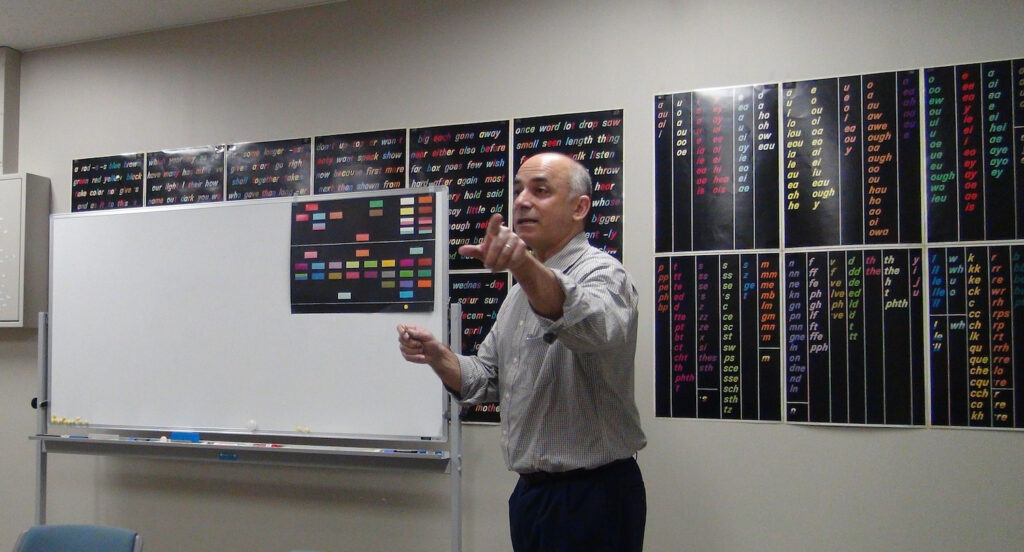
Pointing by the student is a great diagnostic tool, often allowing us, and them, to pinpoint exactly what is the source of mistakes. For example, we don’t always know if a student mispronounces a word whether it’s a) because they have the wrong sound in mind, or b) whether they just haven’t yet mastered how to make that sound. And indeed, there might also be a problem with how they think the word is spelt. Or it might be that it’s the spelling that’s the root cause of the pronunciation difficulty. Getting the student to point on the relevant charts is a very efficient way of finding out what the source of the problem is. Only once we know this are we able to intervene precisely: otherwise we’re flying blind.
So much of our running the class and getting students to talk and giving feedback is better done non-verbally by pointing, gesture, facial expression and mime. Apart from anything else, this means we teach better across linguistic boundaries. Everyone, whatever their native language, comes to know what we mean them to do when we point to a sequence of words on the charts, or wiggle a finger when using finger correction, or gesture the contour of the melody of a sentence, or make the ‘maybe’ gesture, or the ‘try again’ gesture or whatever.
Watch this video to find out more about working with a pointer and charts.
Excerpt:
Pronouncing a language is a motor skill. And it is one of the most difficult motor skills to teach–neither the teacher nor students can see the movements required. Mostly, trying to copy what the teacher says doesn’t work very well. Much better is for the students to experiment with guided coaching from the teacher.
Full content:
To speak, one moves a set of muscles in complex ways: pronouncing a language is a motor skill. Not only that, but it is one of the most difficult motor skills to teach, since neither the teacher nor the students can see the movements required for the language being learned.
It has been known for a century now that at least 90% of students are unable to hear a foreign language faithfully; their own language masks the sounds of the new one. If only for this reason, speaking a sound or word for the students to copy is not a good approach.
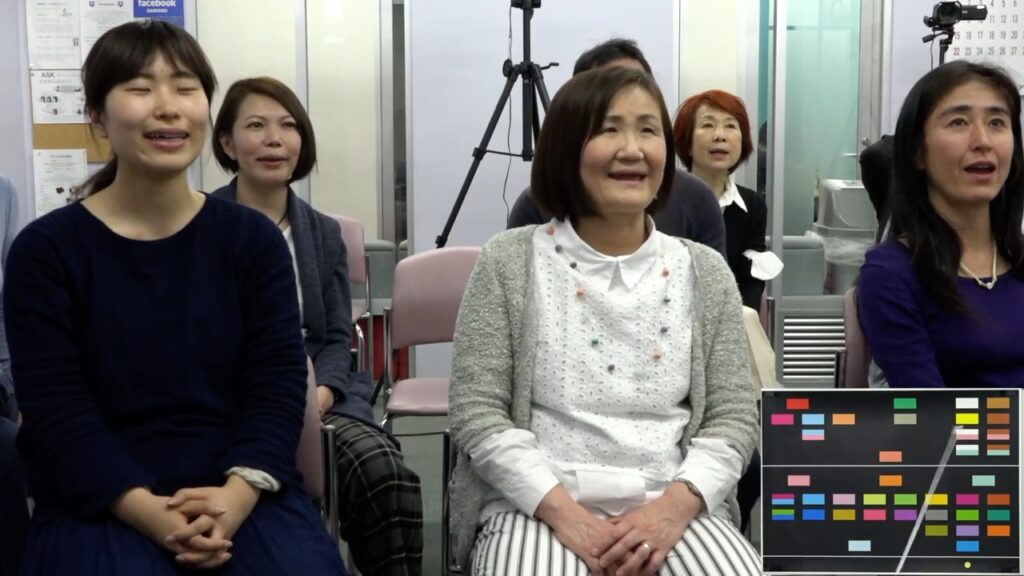
The best way to attain good pronunciation is for the students to be given guided coaching by the teacher. The teacher listens to the sounds produced by the students and guides them in how to modify what they do so that it becomes a sound from the language they are learning. She does this by asking the students to physically move their mouths: to round their lips; to pull their tongue back or move it slightly forward; to have a little more or a little less tension in their lips; or many other physical things that one can do with oneself when making sounds.
She never makes the sound herself. This would immediately be taken as a 'model' to be copied, and we know that this doesn’t help most students.
Since pronouncing is a physical activity, it will take time to put into place; the gestures of a sport cannot be learned and made automatic in a few minutes, and pronunciation must be likened to a sport in this regard (see Pronunciation Science for more information). It will require constant attention throughout the duration of the class, but in the form of opportunistic, micro-lessons lasting from ten seconds, for a reminder, to a few minutes if an important adjustment is required.
Pronunciation must be taught from the very beginning of a course, since potentially every sound is required in every sentence spoken. This is why typically, every Silent Way course begins with an hour or two of intensive work on learning to pronounce the new language. If there is a wide gap between the pronouncing of the students’ native language and the way the foreign one they are learning works, then another hour at the start may be necessary.
This video illustrates some of these techniques in a Silent Way English class given in 2012 in Tokyo by Don Cherry:
Excerpt:
No one is aware of the foundations on which their native language is built, but these deep habits are built on these foundations. And these things all work in combination to make the language easy to speak for natives. So as teachers we need to uncover the foundations of the language, and then find ways of teaching them.
Full content:
No one is aware of the foundations on which they have built their native language, but very deep habits are built on these foundations. And these habits all work in combination to make the language easy to speak for natives. For example, the way English speakers use the breath makes the mystery of stress, reduced (low energy, unclear) vowels, aspirated consonants automatic (with practice). And the English tongue position makes possible the clusters of consonants characteristic of the language.
So as teachers we need to uncover and clarify for ourselves the foundations of the language we are teaching, and then find ways of enabling our students to act in new ways, to suppress their normal linguistic habits and make the new ones automatic. Then our students can forget about them and express themselves with freedom.
Excerpt:
The first step to sounding native is sounding different. Once we make different sounds then we can pay attention to what we did different with our muscles and repeat the experience. This way we start to escape the grip of our native speech. It’s then a matter of trial and error, feedback and practice to home in on exactly what natives do.
Full content:
Excerpt:
We focus on the parts of the language which are difficult for students to learn for themselves: its pronunciation and the use of its functional vocabulary to express temporal, spatial and personal relationships. Gattegno called these the 'spirit of the language'. Once you have the 'spirit of the language', then the rest comes easily through use.
Full content:
We focus on the parts of the language which are difficult for students to learn for themselves: its pronunciation and the use of its functional vocabulary to express temporal, spatial and personal relationships. Gattegno called these the 'spirit of the language'. And this is not some mystical concept.
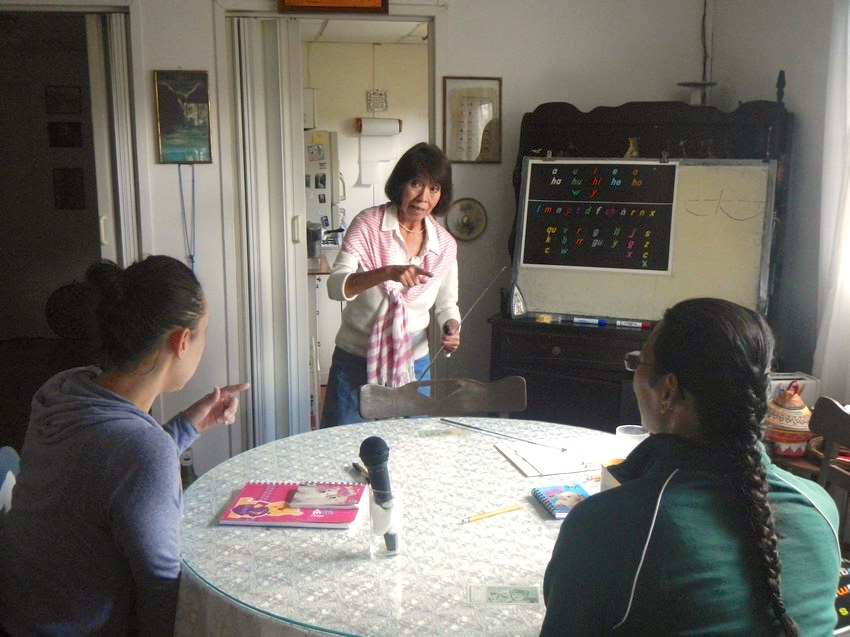
Once you have all these, then the rest—vocabulary, expressions, idioms, literature—comes easily through use. If you don’t have the spirit of the language, then learning all the rest is much more difficult.
Excerpt:
The number system is a great way to practise a lot of language skills with a tiny vocabulary and with no doubt about meaning. For example, in French, you only need 22 words to get to 99 and just two more to get to 999,999. So practising numbers is a great example of ‘much language with little vocabulary’.
Full content:
The number system, for most languages, is a great way for beginners to practise a lot of language skills with a tiny vocabulary. For example, in French, you only need 22 words to say all the numbers up to 99 and just two more to get to 999,999. So practising French numbers is a great example of ‘much language with little vocabulary’ - you can generate nearly a million words with a very small memory burden.*
And with numbers, there is never any doubt about the meaning of what we’re working on.
And for most languages the numbers form a system which students can very quickly grasp and with a little practise become fluent in using. Indeed, the combination of a system and a small vocabulary means that students can very quickly become as good as native speakers at working with numbers - counting up to infinity, doing sums, saying the times tables and doing simple arithmetic. This is a tremendous morale booster: being able to do something as well as natives in a foreign language feels quite something.
English speakers are often taught the French number system as something difficult and complicated. But once they become aware that it’s a simple system made up of just a few words combined in simple patterns that can be grasped and worked with as a whole, it becomes rather easy to master. Just watch this video to see this, in action, to learn how to construct the tens in French.
At the same time, when we teach our beginning students numbers:
- we’re working on every aspect of pronunciation, rhythm and melody.
- and they’re practising saying very long sentences in the language: it feels good to be able to say by yourself 7,895,432,222,674,879,004,231 in a new language! Just count the words! It’s a long, long sentence.
- and they're learning to control their breath, string together all those words and evoke them one by one, on the fly, as they need them. Of course, they need to build up to this ...
One word of caution though ... it’s a bad idea to teach numbers in order. Your students need to be able to evoke the word ‘cinq’ immediately whenever they see five coins, or buses or houses or people without having to count ‘un, deux, trois, quatre, cinq’. So make sure you jump around from number to number as you teach them.
* This makes sense for the vast majority of languages, where the number system employs a small number of words combined together in simple patterns. However, there are exceptions, for example Hindi, where learning numbers requires a rather large memory burden.
Working with the clock and the calendar
Excerpt:
These are the perfect tools to start the class learning about time, and how the foreign language expresses different shades of meaning through tenses and its other arbitrary conventions. But beware! Keep it real!
Full content:
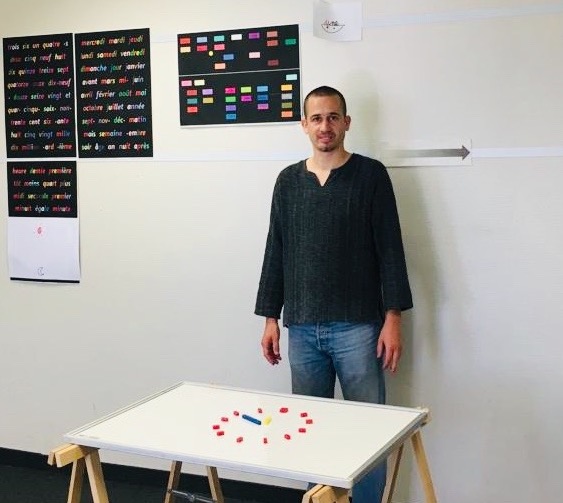
There is more than enough material in all of our students lives and experiences for them to talk about the now, the yesterday, the distant past, tomorrow, next month, their dreams hopes and fears ... without having to use text book examples, manufactured situations or role plays.
Excerpt:
Each language has its own standard position and state for the lips and the tongue; different languages use the breath differently; and, for some languages the general level of tension in the muscles of the face is high, whilst for others it is more relaxed. (called its 'Articulatory Setting')
When we try to speak another language, we cannot do it well without adopting a new setting, and growing a new set of habits
Full content:
You couldn’t play tennis by adopting the stance to drive a golf ball, or basketball if you moved like a tightrope walker. You couldn’t play the trumpet if you breathed like a harpist or the guitar if you held it like a cello.
The same applies to languages. Each language has its own standard position and state for the lips and the tongue; different languages use the breath differently; and, for some languages the general level of tension in the muscles of the face is high, whilst for others it is more relaxed.
These positions and states are called the Articulatory Setting for a language. For our native language, we are completely unaware that we are adopting this setting, just as an expert sportsperson is unaware what they are doing when they step onto the field. We are so well practised at adopting these postures and states we can barely notice them.
But when we try to speak another language, we cannot do it well without adopting a new setting, and growing a new set of habits: some sounds in the foreign language will be impossible to make with the setting of our native speech, and common combinations of sounds in the new language will be very awkward to make, if we do not adopt the native position of the tongue or state of the lips or use of the breath.
On the other hand, if we train ourselves to use ourselves in the way natives do, then everything suddenly becomes easier. Therefore, we are well advised to spend time learning about and working on these fundamentals with our students.
Students of English need to learn how to keep the tip of their tongue ready to regularly tap on their alveolar ridge or nearby as they say the consonants that occur so regularly in the language. Whereas students of French will discover that it is impossible to say most of the French vowels unless the tip of their tongue is pressed against the back of their lower teeth.
Otherwise when our students try to speak the language they are learning, they will be like someone trying to ski with their skis on backwards, or a footballer trying to score wearing spiked running shoes or a tennis player serving with a golf club instead of a racket.